
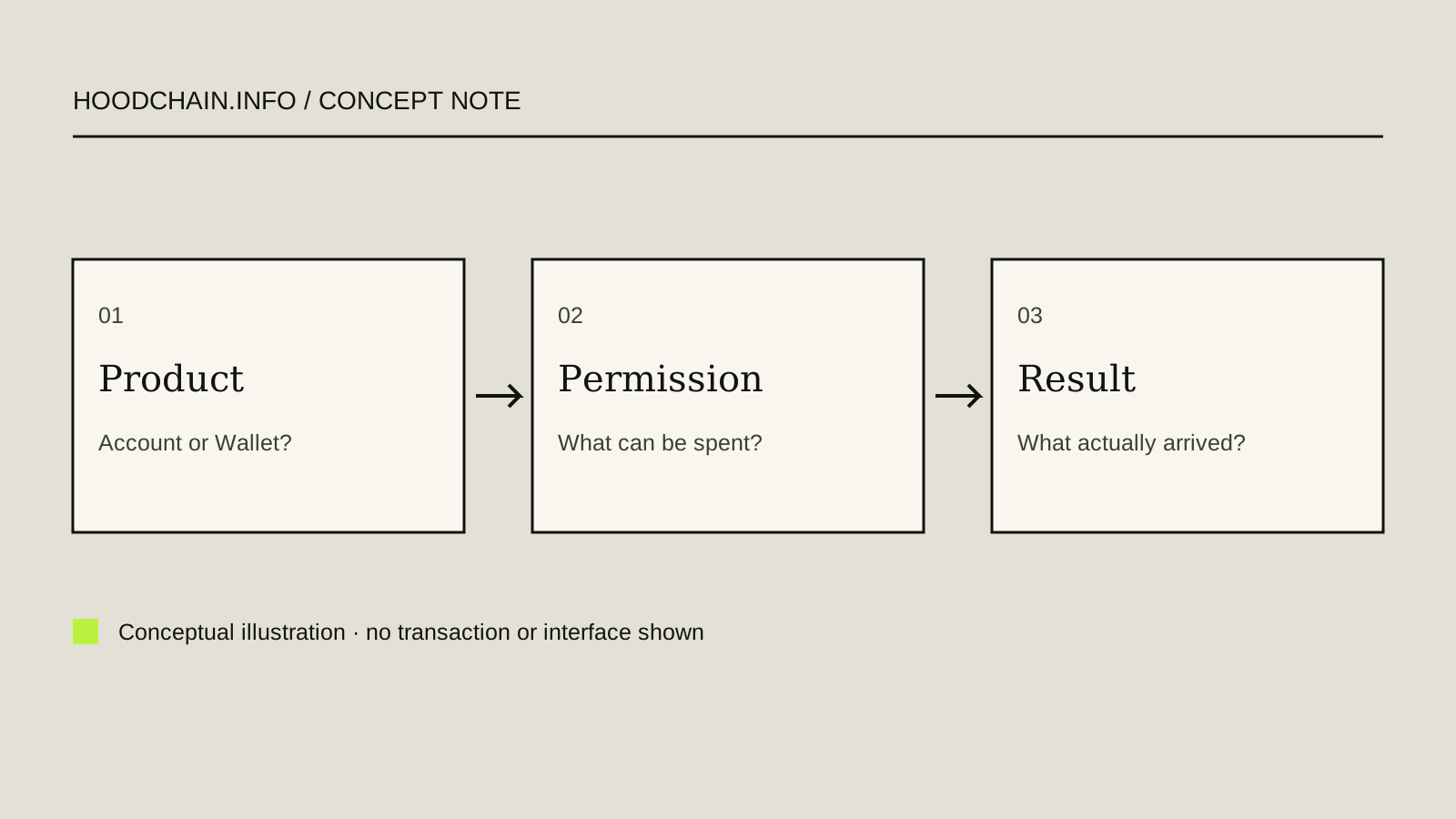
First identify where the authorization happens
A brokerage equity order, a US Robinhood Crypto account order and a Robinhood Wallet swap are different operations. A shared app brand does not give them the same custody, instrument, permissions or execution process.
The self-custody Wallet documentation describes swap routes using aggregators, supported networks and tokens. That does not mean every asset can be swapped on every network, or that a chain's existence establishes an account's eligibility. Check the product, region and exact route.
Three different records to read
| Action | Record to inspect | Separate question |
|---|---|---|
| Brokerage equity order | Instrument, order conditions, fills and account history | What rights and account terms apply to the security? |
| US Crypto account order | Crypto order type, quantities, execution prices and fees | Is the resulting balance available to send? |
| Self-custody Wallet swap | Token deployments, source/destination networks, quote, permissions and transaction result | Did an approval occur, or did the asset exchange complete? |
A Stock Token is not automatically direct ownership of a share. EU Classic Stock Tokens and RHJ onchain Stock Tokens also have different product rules; use the instrument guide rather than applying the equity row to every token with a stock ticker.
Wallet gas is a network cost, not a brokerage commission
This section concerns a self-custody Wallet action. A swap quote, an application or route fee, and network gas are different line items. Network gas pays for execution on the selected chain; the required asset and amount depend on that network and the action. Robinhood Chain documentation names ETH as native gas on Robinhood Chain only. Do not carry that rule to every network shown in a Wallet.
Wallet help describes route-specific sending, swapping and fees. A sponsored or “gasless” experience is conditional on the particular operation and provider; it is not a general promise that every Wallet action needs no gas or has no cost. Check the exact network, asset, quote, fee breakdown and any sponsorship label in the current screen before authorizing. If the parts are not clear, stop and consult the product’s official support.
Fictional fee-label exercise
Teaching fixture W-GAS-01 is invented: a Wallet preview labels a network fee as 0.003 NATIVE units and a separate route fee as 0.50 ROUTE units. No real quote, supported route or price is represented. The answer is that these are two differently labeled costs; do not add them as one token amount or call either a brokerage commission. The fixture does not show sponsorship, fiat value, or whether a route is available. Those facts remain unknown until a supported current screen identifies them. No quote, wallet connection or transaction was tested for this lesson.
Read the swap quote and its boundaries
Wallet support distinguishes quote types and describes slippage, fees and supported routes. Slippage tolerance is an execution-price boundary, not a fee and not a remedy for every failure. A broader tolerance can allow a less favorable result; it cannot establish contract safety.
Read the output asset and deployment, network, estimated or bounded output, expiry or refresh conditions, route and complete fee breakdown. Some costs can be separate from the displayed swap rate. A failed onchain action can still have a network fee. Cross-chain routes add delivery and failure questions beyond a single-network exchange.
Fictional wallet note W-01
Invented note, not a real token, wallet screenshot or quote. W-01 shows an estimated output of 100 practice Y units, a supplied minimum of 99, and a separate request to approve spender S for 50 practice X units. The only receipt supplied is Approval; no swap-result event or output balance is provided, and fee details are missing.
Can you conclude the user now owns 100 Y? Is the minimum output an extra fee? What evidence would establish the outcome?
Show the evidence-based answer
No output holding is established. A quote describes a potential exchange and the supplied approval grants permission; neither is evidence of a completed swap. The minimum is an execution condition, not a fee. A real case would need the relevant swap result, received token/deployment and destination balance, plus the actual fee record. W-01 supplies none of that, so no final amount or cost can be calculated.
When a wallet asks for something unexpected
If the task is only to inspect a quote, do not treat an unexpected signature as a necessary reading step. Compare the spender, allowance and network with the intended action. Disconnecting a site does not by itself undo a permission already granted; the permission guide explains that boundary.
For a stalled cross-chain swap, use its route-specific status and official support. Do not promise that every failed route returns the same token or amount. No swap, approval, fee payment or wallet connection was performed for this lesson.
A safe swap review can stop before any authorization
- Identify the product: a self-custody Wallet swap is an onchain request; it is not a custodial Robinhood Crypto service order.
- Match the input and output asset by exact network and contract, not ticker alone. Confirm the route provider and whether it is same-chain or cross-chain.
- Read the quote type and time/refresh condition, expected output, minimum output or slippage limit, route, network fee/gas and any separately disclosed fee.
- Inspect any approval request separately: token, spender, amount/cap, network, and any stated expiry. A swap quote does not itself mean an approval or transaction occurred.
- After an actual operation, use its displayed status and matching public receipt to distinguish request, approval and swap outcome. If the fields conflict or are missing, stop and use the product’s official support path; do not repeat a request based on a guess.
Robinhood Wallet help says quotes may be guaranteed or estimated and describes slippage boundaries and route requirements for the supported product snapshot. A quote can change or fail; minimum output is not a promise that a swap completes. Network gas, route/provider charges and price movement are distinct. The brokerage order screen has different order types, custody and execution records.
Fictional quote exercise W-48: output floor and failure state
Invented, non-operable quote: input 100 practice Q; quoted output 1.00 practice R; displayed minimum output 0.98 R; network fee shown separately as “estimate unavailable”; route provider “Example Aggregator”; quote state “estimated”; no approval or transaction submitted. The floor is 0.02 R below the quote, or 2% of the quoted output. That is only arithmetic from the fixture, not an observed market slippage or a Robinhood setting.
Answer key: the record shows a quote, not ownership of R. Because it is estimated and the fee is unavailable, total cost and executable result are unknown. If an eventual output were below 0.98 R, the fixture says the route would not meet that displayed floor; it does not prove whether a transaction was ever broadcast or whether funds were returned. No real token, wallet, provider or fee was queried.
Fictional lifecycle case W-48B: quote, approval and swap are separate
Invented record; no real token, app screen, network transaction or hash. Stage 1: a quote card says “route unavailable”; no swap transaction evidence is supplied. Stage 2: a separate approval record is visible, but no swap request is shown. Stage 3: a later fictional swap request is marked pending/unconfirmed, with no hash or receipt supplied. Stage 4: a fictional provider note reports “DEX error”; it does not say whether a network transaction was included or whether any fee was charged.
Answer key: Stage 1 establishes only that this record has no route quote and supplies no transaction evidence; it cannot prove that nothing happened elsewhere. Stage 2 is an approval, not proof of a swap. Stage 3 remains unresolved: Robinhood Wallet help says pending or unconfirmed status may relate to network volume, confirmation speed or transaction size, but those are possibilities, not a diagnosis. Stage 4 is a reported DEX error; the cause, onchain state, fee outcome and any recovery remain unknown without matching provider and network evidence. Do not repeat the request based on this fixture; check the exact route's official status/support and matching records.