
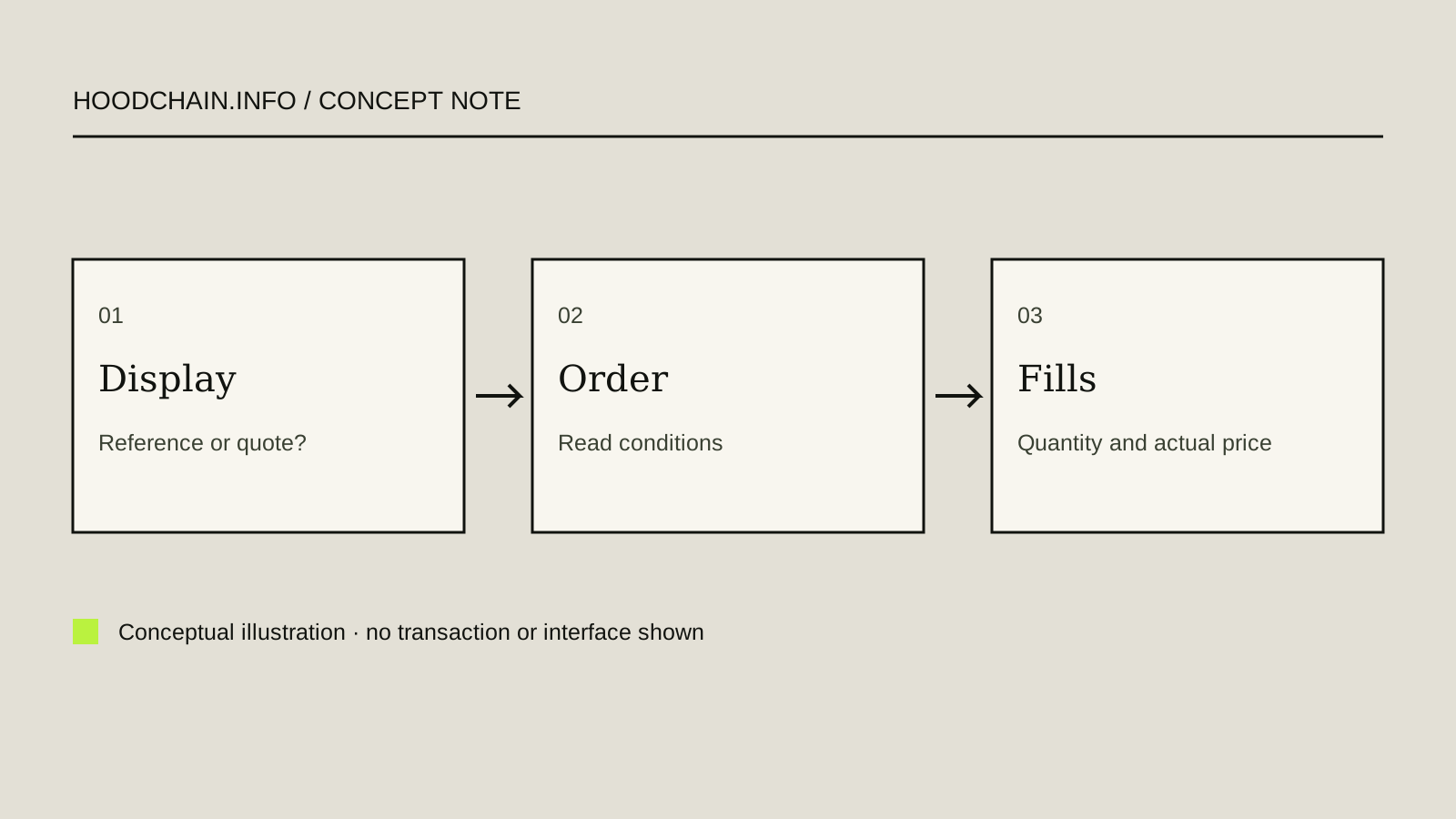
Read the product and the condition before interpreting a price
This guide is educational and scoped: the detailed order rules below are from US Robinhood Crypto support reviewed 26 October 2026. Robinhood Financial brokerage orders and Crypto service orders are separate products. UK crypto service is via Bitstamp UK Ltd; EU services and account features can differ. Do not apply US controls to another entity or Wallet.
A safe review is read-only: identify the product and region, open the asset’s current information, read the displayed quote, order type, conditions, fees and preview, then stop before any final submit action. Nothing here places or recommends an order.
A no-submit walkthrough
Fictional case O-01: a sample US Crypto screen for practice asset Q shows a reference mid of $100, a market-buy estimate, a maximum-price condition and a separate fee disclosure. The reader confirms this is a custodial Crypto service, checks asset and order type, calculates whether the conditions fit the hypothetical example, and does not press Submit. The fictional record contains no account or live quote.
Walk through the answer
The product label determines which rules and terms apply. A reference mid is not an execution; the estimate and any fee disclosure are separate inputs. Without a submitted order and recorded fills there is no trade to reconcile. Stop at the review screen; no account, funds or order are needed to understand the fields.
Bid, ask and mid are different reference values
- Best bid
- Highest price a buyer is willing to pay in the referenced market for its available quantity.
- Best ask
- Lowest price a seller is willing to accept in the referenced market for its available quantity.
- Mid price
- The arithmetic midpoint of bid and ask; it is a reference, not a promised fill.
Fictional snapshot P-02: bid $99.90; ask $100.10. mid = ($99.90 + $100.10) / 2 = $100.00; quoted spread = $0.20, or 0.2% of the $100 midpoint.
A market buy can execute against asks, potentially at different levels as depth and price movement change; it is not guaranteed to fill at the mid or the displayed ask. A chart line or reference quote does not prove a particular execution.
Market, limit, stop and stop-limit conditions
The US Crypto support page reviewed 26 October 2026 describes market, limit, stop and stop-limit orders. A market order seeks execution under the service’s conditions; it does not set one exact price. A limit order sets a price boundary: a buy is eligible when the ask is at or below the limit, and a sell when the bid is at or above it. Eligible does not mean filled: available quantity matters.
A stop condition can trigger a market order; a stop-limit triggers a limit order and can remain unfilled if its limit is not reached. The same dated US page describes price collars for market orders and possible automatic cancellation when the collar is exceeded. Parameters and supported controls can change; check the current product flow and disclosures.
Fictional case O-02: a buy limit is $100, while the available ask remains $100.20. It is not eligible at that moment. If the ask later becomes $99.90, the limit may be eligible, but depth, movement and order handling still determine whether any amount fills. No order was entered.
Solved stop vs stop-limit case O-03
Entirely fictional, non-operational example: practice asset Q has an ask of $100.00. Two hypothetical buy instructions each use a $102.00 stop. One is a stop order; the other is a stop-limit with a $102.25 limit. While the ask stays below $102, neither trigger has been reached, so neither order is triggered.
If the ask reaches $102, the stop order becomes a market buy. It seeks the best available ask under the current US Crypto market-order conditions; the trigger is not a guaranteed $102 fill or a guarantee of any fill. The stop-limit instead becomes a buy limit capped at $102.25. At an ask of $102.20 it is price-eligible, but available quantity and execution handling still determine whether it fills. If the ask jumps to $103.00, it is not price-eligible at that moment; it can remain unfilled rather than converting to a market order.
Answer key for O-03
Before $102: neither is triggered. At the $102 stop: stop becomes market; stop-limit becomes limit with maximum $102.25. At $102.20 ask: the limit is eligible, not guaranteed filled. At $103.00 ask: the stop-limit buy is not eligible, while the stop-market order follows market-order conditions and is not guaranteed to execute at the trigger price. All prices are invented; no order was entered.
A price condition does not guarantee quantity
Keep requested amount, limit/trigger, available depth, filled quantity and remainder distinct. Price collars, insufficient order depth, limit not reached and scheduled maintenance can contribute to an unfilled US Crypto order according to the cited support pages. These are possible documented explanations, not a diagnosis of an individual account.
For a stop-limit, a trigger does not guarantee the resulting limit is filled. For a market order, a collar may constrain the acceptable price and the provider may cancel under its documented rules. Avoid interpreting a chart touch as a fill.
Fictional order record Q-01
Invented record, not a Robinhood screen or executed trade. A buy request is 10 practice units, limit $10.20. Recorded fills: 4 at $10.10 and 2 at $10.15; remainder 4; cancellation request awaiting confirmation; fee field blank.
How many units filled and what is their gross cost? Is all 10 filled? Does the pending cancellation erase fills?
Answer key
Six filled units cost 4 × $10.10 + 2 × $10.15 = $60.70 before unspecified costs. 4 units remain unfilled. A pending cancellation request does not establish cancellation or undo the recorded fills. An all-in total cannot be calculated with the fee field missing.
Pending, partial, filled and canceled describe different evidence
For an existing order, read its status with timestamp, type, conditions, fills and remainder. “Pending” alone does not reveal whether a trigger, collar, depth, maintenance or another service condition is responsible. US Crypto support describes orders that may remain pending when a limit is not met or maintenance is active, and orders that can be canceled under collar rules. Do not infer the cause from one label.
“Partially filled” needs filled and remaining quantity. “Filled” requires an execution record. A cancellation request and its confirmed result are not the same state. If the actual order history does not explain a discrepancy, use the official support path; do not resend to test it.
Service trading hours are not network availability
The dated US Crypto support page describes crypto trading as available 24/7 except for scheduled maintenance. The UK Bitstamp UK support page also describes its crypto service as 24/7; that statement applies to that service only. No general EU schedule is asserted here.
A custodial service’s trading window, asset eligibility, scheduled maintenance and order routing are separate from whether a public blockchain is producing blocks or a transfer is supported. Trading availability does not prove that an asset can be withdrawn on a particular network. Check the current product-specific availability and transfer guidance; do not rely on a static coin list.
For separate costs see crypto fee categories; for recurring schedules see recurring-buy rules; transfer checks are in the transfer checklist.
A read-only review note
Write down product, region, order type, condition, quote timestamp, fee disclosure, status time, fills and remainder. Compare them with the current official source for the same entity and region. No live quote, account or execution was checked for this lesson.
For a wallet swap, read the wallet-swap comparison; an onchain swap and custodial order have different evidence and fees.