
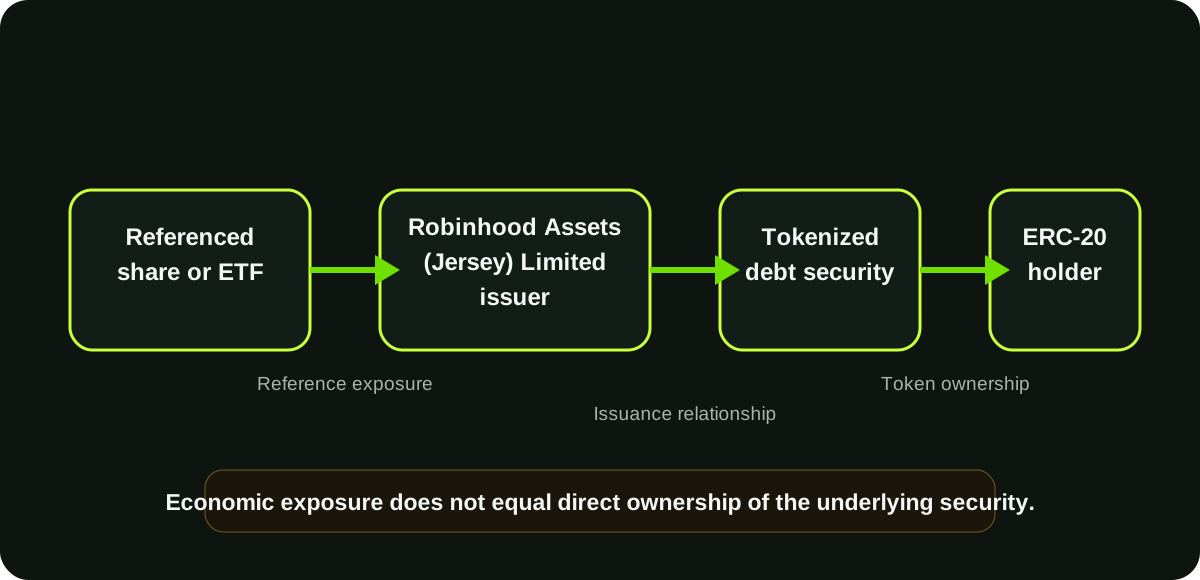
Robinhood Stock Tokens are ERC-20 tokenized debt securities issued by Robinhood Assets (Jersey) Limited. They are designed to provide economic exposure to specified underlying shares or ETFs, but they do not give holders legal or beneficial ownership of those underlying securities. They can be held and transferred onchain where eligible, use Chainlink price feeds, and incorporate dividends and stock splits through an onchain multiplier. They are high-risk products with significant jurisdictional restrictions.
Important ownership distinction
Robinhood Stock Tokens are tokenized debt securities. Holding one does not make you the legal or beneficial owner of the referenced share or ETF, and it does not automatically grant shareholder voting, custody, or direct-redemption rights.
- Issuer
- Robinhood Assets (Jersey) Limited (RHJ)
- Legal form
- Tokenized debt security
- Token standard
- ERC-20, 18 decimals
- Economic reference
- Specified equity or ETF
- Ownership of underlying
- No legal or beneficial ownership granted
- Onchain pricing
- Per-asset Chainlink feeds
- Corporate actions
- Handled through an onchain multiplier
- United States availability
- Not offered or deliverable to U.S. persons under the stated restrictions
The most important distinction
A Stock Token can track the economic performance of a share without making the token holder a shareholder of the company. The official documentation says the product provides economic exposure but does not grant legal or beneficial rights in, or against the issuer of, the underlying security.
What a Stock Token actually is
Each Robinhood Stock Token is a blockchain token and a debt security issued by RHJ. The token identifies an underlying equity or ETF and is implemented as a standard ERC-20 contract with 18 decimals.
The token can be stored in a compatible wallet, transferred, and integrated into smart contracts. The fact that it is composable does not change the legal instrument it represents.
What holders get and do not get
| Potential holder exposure or feature | What it means |
|---|---|
| Economic exposure | The token value is designed to reference an underlying share or ETF. |
| Onchain custody | The token can be held in a compatible wallet. |
| Transferability | Transfers may be technically possible subject to contracts, liquidity, and legal restrictions. |
| Shareholder ownership | Not granted by the Stock Token. |
| Voting rights in the underlying company | Not automatically granted as shareholder rights. |
| Direct claim against the underlying issuer | Official documentation says no legal or beneficial rights in or against that issuer. |
| Protection from loss | None; official disclosures classify the product as high risk. |
How pricing works
Official documentation states that every Stock Token has a live Chainlink price feed. Applications can read those prices onchain. A reference feed does not guarantee that every exchange or liquidity pool will trade at the same price.
- Pool liquidity can produce slippage.
- Market dislocations can create premiums or discounts.
- The underlying market may be closed while the token remains transferable or tradable.
- Oracle design, update rules, contract behavior, and venue liquidity all affect the observed experience.
- A wallet’s displayed price can be stale or sourced from a different provider.
Dividends, splits, and the multiplier
Robinhood documentation describes an onchain multiplier used to manage dividends and stock splits. The shares-per-token ratio can change while the raw token balance remains static until redemption. The interface-adjusted amount can be read through the token’s uiMultiplier() function under ERC-8056.
For users, this means a raw token balance alone may not communicate the full economic position. Interfaces and protocols integrating Stock Tokens must account for the multiplier correctly.
How Stock Tokens reach the market
The official documentation says only authorized participants may subscribe directly from RHJ after business onboarding in the primary market. At the time of the documentation, BBVI is identified as the only authorized participant. Most developers and users therefore interact with existing tokens rather than minting directly from RHJ.
Acquisition, redemption, and market access may involve separate entities, venues, terms, identity checks, and jurisdictional restrictions.
How can eligible users acquire Robinhood Stock Tokens?
Availability depends on jurisdiction, product terms, the token, and the service being used. Eligible users may encounter three broad access paths:
Robinhood Wallet
A user can create or import a wallet, activate Robinhood Chain, fund it with supported assets and ETH for gas, and locate an available Stock Token. The exact contract and transaction preview must still be verified before signing.
Decentralized exchanges
A compatible DEX may provide a market where permitted. Users must verify the network, canonical contract, liquidity, slippage, approvals, and gas balance. A token appearing in search results does not prove it is official.
Centralized services
Availability, custody, withdrawals, supported jurisdictions, and product structure vary by provider. A similarly named product on a centralized platform should not automatically be assumed to be the same transferable onchain instrument.
Important: availability through a wallet or interface does not mean every Stock Token is available to every user.
Canonical contracts and fake tokens
Robinhood publishes canonical contract addresses. A token can copy the name and ticker of AAPL, NVDA, or another asset without being an official Robinhood Stock Token. Contract verification is therefore essential.
- Open the official token-contract page.
- Match the full hexadecimal address, not only the ticker.
- Check the chain: Robinhood Chain, chain ID 4663.
- Inspect the contract in the official explorer.
- Verify liquidity venue and token pair separately.
- Treat unsolicited token airdrops as untrusted until verified.
The current official list includes tokenized equities and ETFs such as AAPL, AMD, AMZN, GOOGL, META, MSFT, NVDA, QQQ, and SGOV, among others. The list can change, so this site does not replace the canonical registry.
Availability and geographic restrictions
Stock Tokens are not universally available. Official disclosures state that they are not registered under U.S. securities laws and may not be offered, sold, or delivered in the United States or to U.S. persons. Restrictions also apply in other jurisdictions, including specific statements concerning Canada, the United Kingdom, and Switzerland.
Technical access to a wallet or decentralized application does not remove legal restrictions. Users must determine whether receiving, holding, transferring, trading, or promoting the product is permitted where they reside or operate.
DeFi composability
Because Stock Tokens use standard ERC-20 interfaces and onchain prices, developers can theoretically integrate them into wallets, exchanges, lending markets, structured products, collateral systems, and portfolio tools.
Composability creates additional dependencies. A lending protocol may add liquidation risk; a liquidity pool may add impermanent loss and slippage; a bridge may add cross-chain risk; a wrapper may change redemption or counterparty exposure. The original token’s documentation does not automatically cover every downstream protocol.
Risk framework
- Market risk: the referenced security can fall in value.
- Issuer and credit risk: the token is a debt security issued by RHJ.
- Liquidity risk: onchain markets may be thin or fragmented.
- Smart-contract risk: token, venue, bridge, or integration contracts can fail or be exploited.
- Oracle risk: applications rely on price data and integration logic.
- Wallet risk: private-key loss or malicious signatures can cause irreversible loss.
- Legal and transfer risk: restrictions can affect who may acquire, hold, transfer, or redeem.
- Tracking risk: venue prices may diverge from reference values.
- Operational risk: interfaces, sequencers, RPCs, and service providers can become unavailable.
How can a holder exit or redeem a Stock Token?
A holder may be able to exit through an available secondary market, transfer the token where permitted, or use a redemption arrangement supported under the applicable issuance and distribution structure. The exact process depends on current legal documents, eligible participants, service providers, fees, settlement rules, and jurisdiction.
At launch, Robinhood documentation identified BBVI as the Authorised Participant involved in the primary issuance and redemption structure. That does not mean every retail holder can directly demand delivery of the underlying share from the issuer or from an Authorised Participant.
Can Stock Tokens create tax obligations?
Potentially. Buying, selling, swapping, transferring, receiving distributions from, or redeeming a Stock Token may have tax consequences depending on country, tax residence, transaction history, and legal classification.
Hoodchain.info does not provide tax advice. Keep records of transaction dates, wallet addresses, quantities, fees, values, distributions, and redemption details, and consult a qualified professional in the relevant jurisdiction.
Frequently asked questions
Are Robinhood Stock Tokens real stocks?
No. They are tokenized debt securities designed to provide economic exposure to underlying shares or ETFs, not legal or beneficial ownership of those securities.
Do Stock Token holders receive voting rights?
The token does not grant the shareholder rights that arise from owning the underlying share.
Can Stock Tokens pay dividends?
Official documentation describes dividends and splits being handled through an onchain multiplier that adjusts the economic ratio.
Can U.S. persons buy Robinhood Stock Tokens?
Official disclosures state that the products may not be offered, sold, or delivered in the United States or to U.S. persons.
How can I verify a Robinhood Stock Token?
Compare the complete contract address with Robinhood’s official token-contract registry. A matching name or ticker is not sufficient.
Are Stock Tokens available 24/7?
The ERC-20 tokens can exist in wallets and onchain applications around the clock, but liquidity, venue rules, underlying-market hours, legal restrictions, and redemption arrangements can affect practical access.
Are Robinhood Stock Tokens safe?
They carry market, issuer, smart-contract, liquidity, wallet, oracle, operational, and legal risks. Official disclosures state they are high risk and not suitable for all investors.
Primary sources
| Source | Type | Last checked |
|---|---|---|
| Robinhood Chain documentation: Stock Tokens | Primary source | 2026-07-12 |
| Robinhood Chain canonical token contracts | Primary source | 2026-07-12 |
| Robinhood Chain Terms of Service | Primary source | 2026-07-12 |
| Robinhood mainnet and Stock Token announcement | Primary source | 2026-07-12 |
Related updates and guides
Explore current reporting and practical guidance related to this topic.