
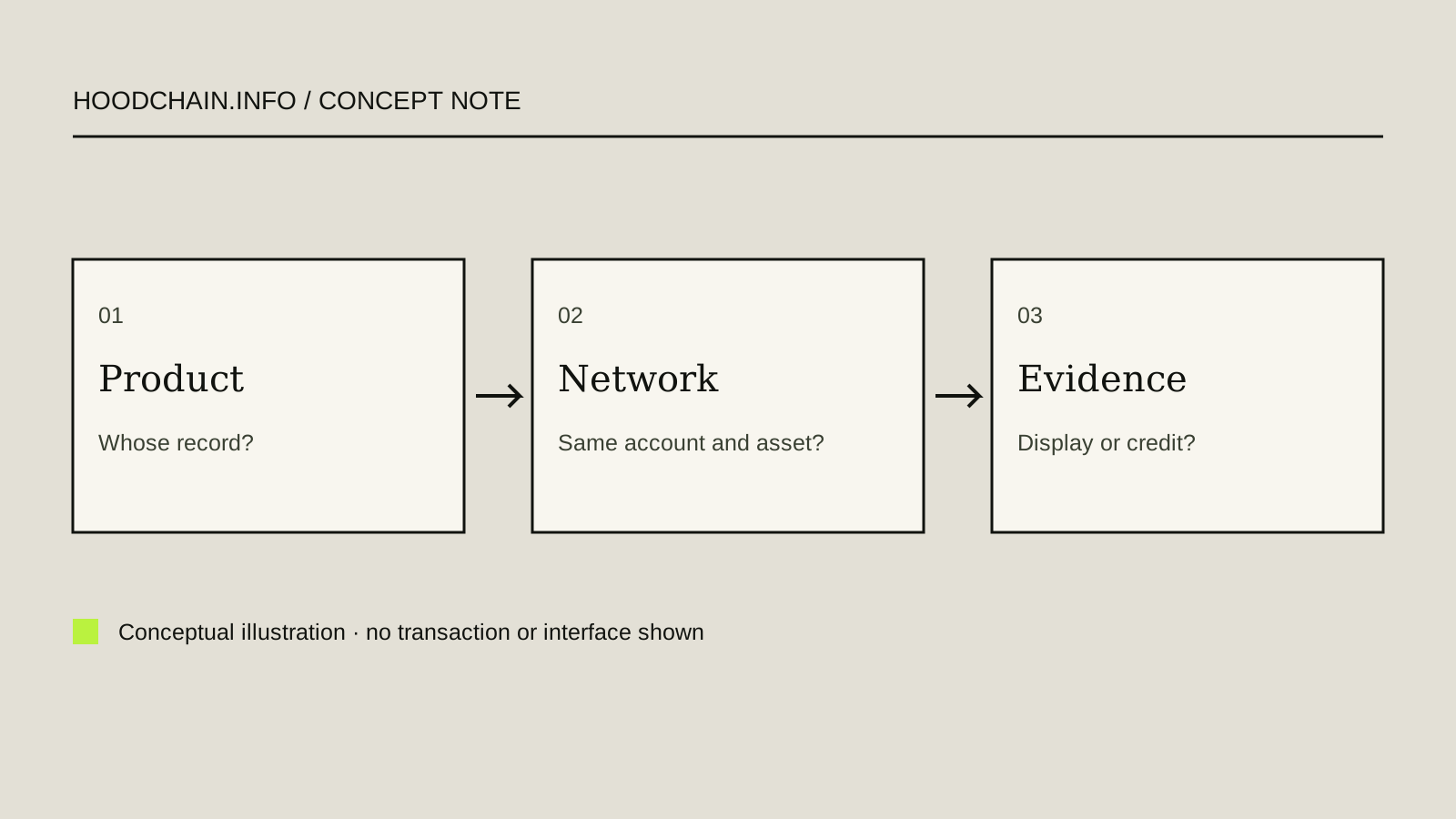
A missing display is a question, not a diagnosis
First identify what is missing: a portfolio value in the Robinhood app, a crypto balance held by a provider, an asset displayed in Robinhood Wallet, or a record on Robinhood Chain. A zero in one view does not by itself prove a loss, a transfer or an outage.
This is a read-only diagnosis. Do not resend, buy gas, import recovery material or connect to a recovery site to complete it. If an unfamiliar outgoing action appears, preserve its public evidence and use the security response guide; this lesson cannot promise recovery.
1. Name the product and who keeps the record
- Robinhood Crypto account, US: the provider keeps your account balance and applies its deposit-crediting process. Your app balance is not necessarily the balance of a unique address you control.
- Robinhood Wallet: a separate self-custody product operated by Robinhood Non-Custodial, Ltd. Its keys and account selection differ from the US account provided by Robinhood Crypto, LLC.
- Robinhood Chain: the network recording transactions and balances. It is not the brokerage app or an exchange account. A successful network action cannot update every provider's account ledger automatically.
An exchange or another custodial provider has its own supported deposit routes and crediting rules. Do not apply the US Robinhood Crypto instructions to all regions or to every service bearing the Robinhood name. For cash or purchasing capacity, use the balance-label guide.
2. Gather the minimum public record
Write down the product and region, asset, exact source/destination networks, intended recipient, time, and any public hash or internal request ID already supplied. A request ID is not automatically a blockchain hash. Record what you expected separately from what the evidence shows. Keep account identifiers and private documents inside verified support.
If there is no broadcast evidence, first establish whether the sender actually sent anything. A failed search on the wrong explorer does not prove loss. If there was a bridge, continue with the bridge-stage diagnosis rather than treating the first receipt as arrival.
3. Compare the same account, network and asset
- Reach the explorer through official Chain connection documentation. The reviewed IDs are mainnet
4663and testnet46630. Do not compare a testnet display with a mainnet record. - Compare the complete public recipient with the intended receiving account. A matching address format or a few matching characters is insufficient.
- Identify the asset deployment on that network. A ticker alone is insufficient; native ETH and wrapped ETH are separate assets. A bridged token can have a different contract on each chain.
- Read the relevant current balance and movements at a stated block/time. A receipt is a historical action, not necessarily today's balance. A later outgoing movement can change it.
Wallet display, RPC data and explorer indexing can disagree or lag. A matching public record can narrow the issue to a view or data path; it does not certify a wallet, token or provider. Compare official network/asset support before changing configuration or adding a token. No RPC endpoint, wallet or address was queried for this lesson.
4. If the recorded destination is not the intended recipient
Compare the complete public destination in the transaction record with the exact receiving address obtained independently from the intended receiver’s official deposit instructions. A shortened address, similar prefix, ticker, sender request ID or “sent” label is not enough. Keep the source and destination networks and asset representation beside that comparison.
If a verified onchain record shows a different destination than intended, record that mismatch and the public transaction hash only if one already exists. Do not assume who controls the destination, promise a reversal, pay a stranger for recovery, resend to the same destination, or follow unsolicited recovery links. Transfers may be irreversible; contact the sending and receiving providers through their authenticated official support channels and ask what evidence they can review. A wrong-looking app display without a matching public record remains unresolved, not proof of loss.
For an absent self-custody Wallet display, first compare the selected wallet account, exact network, block/time and exact asset or token contract against public evidence. Do not import a phrase, add a token from a search result, connect to a recovery site or sign a message to make a balance appear. Robinhood Wallet and Robinhood Crypto account records are separate; the provider’s US transfer documentation does not determine Wallet state or rules in other regions.
5. Separate onchain receipt from custodial credit
For a custodial deposit, check the exact asset/network pair, recipient and any required memo against the receiving product's instructions. The US transfer documentation describes confirmation and review requirements before a deposit is available. An onchain success alone cannot establish that your personal account was credited.
Never reuse a service's outgoing withdrawal address as your deposit destination. A service address can handle funds for more than one customer; a public balance does not identify your internal entitlement. If a supported deposit remains uncredited, ask that provider about its actual crediting state instead of sending it again. An unsupported route has no recovery guarantee here.
Fictional records M-01 through M-03
Invented teaching records, not screenshots or live observations. Labels A, P and R are not real addresses, tokens or providers.
| Record | Evidence supplied | Unknown |
|---|---|---|
| M-01 | Correct mainnet record for account A at block B: 12 practice P. Wallet view: account A, chain ID 46630, zero P. | Current mainnet display and any movement after block B |
| M-02 | Source execution succeeded to custodial recipient R; receiving service says credit pending. | Exact supported pair, memo requirement, confirmations and final account credit |
| M-03 | Fictional public record says destination label RECIPIENT-A; the intended wallet label in the exercise is RECIPIENT-B. Neither label is an address or identity. | Whether either label maps to a person or controlled wallet, and whether any provider can assist |
Does M-01 establish a lost balance? Does M-02 establish a credited customer account? What single discrepancy or missing record should each diagnosis retain?
Show the balance diagnosis
- M-01 compares different networks. The zero on testnet does not contradict the supplied mainnet balance at block B. Check the mainnet view and any later movements; do not claim the current balance from the older snapshot.
- M-02 establishes only the supplied source execution and pending service state. Verify the receiving product's exact deposit requirements and crediting record. It does not establish that the account received usable funds.
- M-03, if the fictional record is accurate, shows a destination-label mismatch. It does not identify a controller or prove recovery is possible. Preserve only public evidence, do not resend, and use official support; no address or hash is supplied.
6. Finish with a finding that the evidence supports
A useful result names the product, matching account/network/asset, observed record and time, the unresolved condition, and who can verify it. “Wrong network selected” is a narrower finding than “funds lost.” “Receiver credit pending” is different from “network failed.” If those fields cannot be reconciled, keep the result unresolved and use official support reached from the product itself.
Do not provide recovery phrases, keys or login codes to support, this publication or a stranger. Reading a record requires no signature. A diagnosis is complete when the evidence and next verification are clear; it is not a claim that funds were recovered.