
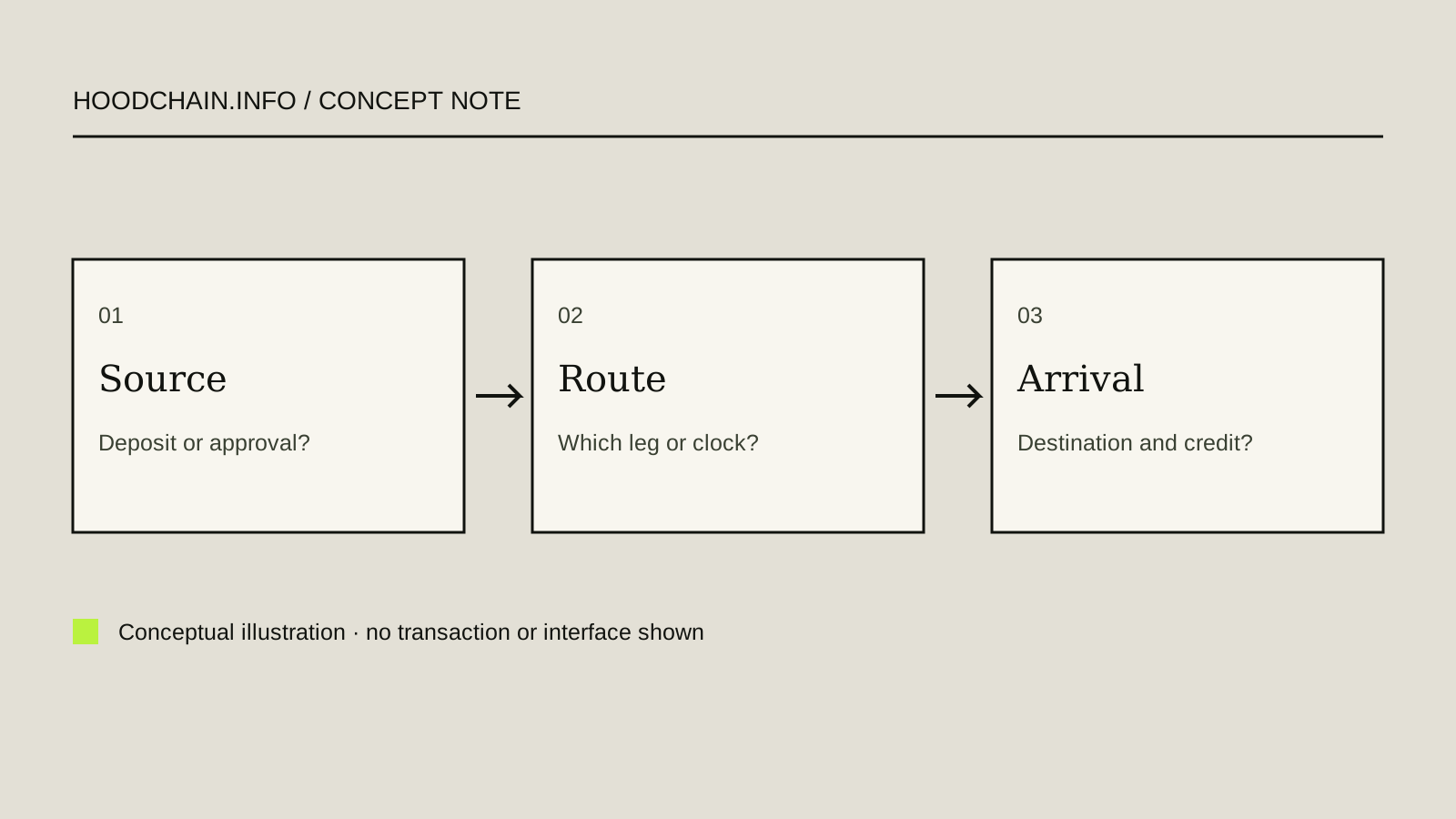
Identify the route before choosing a clock
A pending crypto withdrawal from an account is not automatically a bridge. A same-network send, canonical bridge and third-party cross-chain swap have different stages. Start with the product, source network, destination network, direction, exact asset representation and recipient.
Robinhood Chain is the network. Robinhood Wallet is a self-custody interface. US Robinhood Crypto and other custodial or exchange services maintain their own account processes and supported networks. Neither a Wallet brand nor an exchange's token listing establishes support for your bridge's destination asset. For an account request that was not broadcast, start with the transfer-stage guide.
1. Establish what the source action actually did
Use the source network's correct explorer and the route's official status record. Keep its operation ID, if one exists, separate from a transaction hash. If a service has only an internal request, ask whether broadcast occurred. An absent result on another network's explorer is incomplete evidence.
A reverted source action does not establish a completed deposit; it can still have a fee. A successful approval grants permission but does not itself send assets across the bridge. Read the action and events, not just the green success label. The fictional receipt lesson demonstrates that distinction without a real hash.
2. Canonical Ethereum-to-Chain deposit: inspect the L2 leg
The reviewed Robinhood Chain bridging documentation gives a typical deposit estimate of about ten minutes. It is not an arrival deadline for a particular operation. Source execution and the destination L2 execution are separate evidence.
The documentation describes a specific failed-deposit case: the canonical deposit's L2 execution fails, for example because gas was insufficient. It uses a retryable ticket and documents manual redemption through the bridge interface within seven days. Check the actual ticket state and deadline using the official procedure; do not wait seven days before investigating a failed L2 leg.
Follow the official page's bridge link and applicable Arbitrum deposit troubleshooting documentation to understand that case. This page does not execute redemption, establish ticket eligibility or guarantee recovery after expiry, on another route, for a wrong recipient or for an unsupported asset.
3. Canonical Chain-to-Ethereum withdrawal: separate waiting and claiming
In the reverse direction, the official process is initiation on Chain, an approximately seven-day challenge period, then a separate claim transaction on Ethereum with L1 gas cost. A successful initiation is not evidence that the Ethereum claim happened.
Read the route's actual challenge/claim status rather than deriving a precise eligibility time from a tutorial. If the challenge period is active, the missing destination receipt can be consistent with that stage. If the route shows claim eligibility but no claim record, the final step remains unverified. Understanding this sequence does not require initiating or claiming a real withdrawal.
4. Third-party route: use its own status and asset mapping
Alternative routes can combine messaging, liquidity, intents or a swap. Use the route named in your actual record, reached through the official documentation or verified product link. Do not apply the canonical withdrawal wait or deposit-redemption deadline to every partner route.
Compare the promised output network, token deployment, amount and recipient with the destination record. A swap-and-bridge may produce a different representation of the asset. A route's time estimate is not a guaranteed completion time; an unknown state must remain unknown. Preserve both leg identifiers and use route-specific official support. Do not pay an unsolicited “unlock” or “recovery” deposit.
Three fictional bridge records BR-01 to BR-03
All records and remaining times are invented for learning. There are no real hashes, addresses, tickets, fees or recovery observations.
| Record | Route and evidence | Not supplied |
|---|---|---|
| BR-01 | Canonical Chain-to-Ethereum. Initiation succeeded; route status says challenge active; claim unavailable. | Challenge completion and Ethereum claim |
| BR-02 | Canonical Ethereum-to-Chain. Source succeeded; retryable L2 execution failed; fictional ticket record says 36 hours remain. | Actual redemption eligibility and completed destination execution |
| BR-03 | Source receipt says success; only an Approval event is supplied; no route operation ID or deposit event. | Whether a bridge operation was ever initiated |
Which case is in a withdrawal wait? Which has a failed deposit leg whose documented deadline needs attention? Which does not establish a bridge operation at all?
Show the bridge-stage answers
- BR-01 is waiting in the supplied withdrawal challenge stage. No Ethereum arrival or claim is established.
- BR-02 describes a failed L2 deposit leg. Consult the applicable official ticket/redemption procedure and actual deadline; do not borrow the withdrawal waiting rule. Its fictional 36 hours is not a promise of eligibility or recovery.
- BR-03 proves only the supplied approval. It does not establish an initiated bridge or a pending delivery, so first find an actual route/deposit record.
5. Define arrival and the next useful support record
Arrival evidence must match the destination network, intended recipient and actual token representation. Read destination execution and resulting balance, plus any receiving provider's separate crediting state. For a canonical withdrawal, retain the final Ethereum claim record when it exists. Source success alone is insufficient.
For unresolved cases, preserve the route name/direction, public leg identifiers, operation ID, timestamps, observed state and the exact missing step. Redact private account data; never share keys, recovery words or login codes. A useful diagnosis identifies the stage and missing evidence. No route, current status, delivery time or recovery outcome was tested here.