
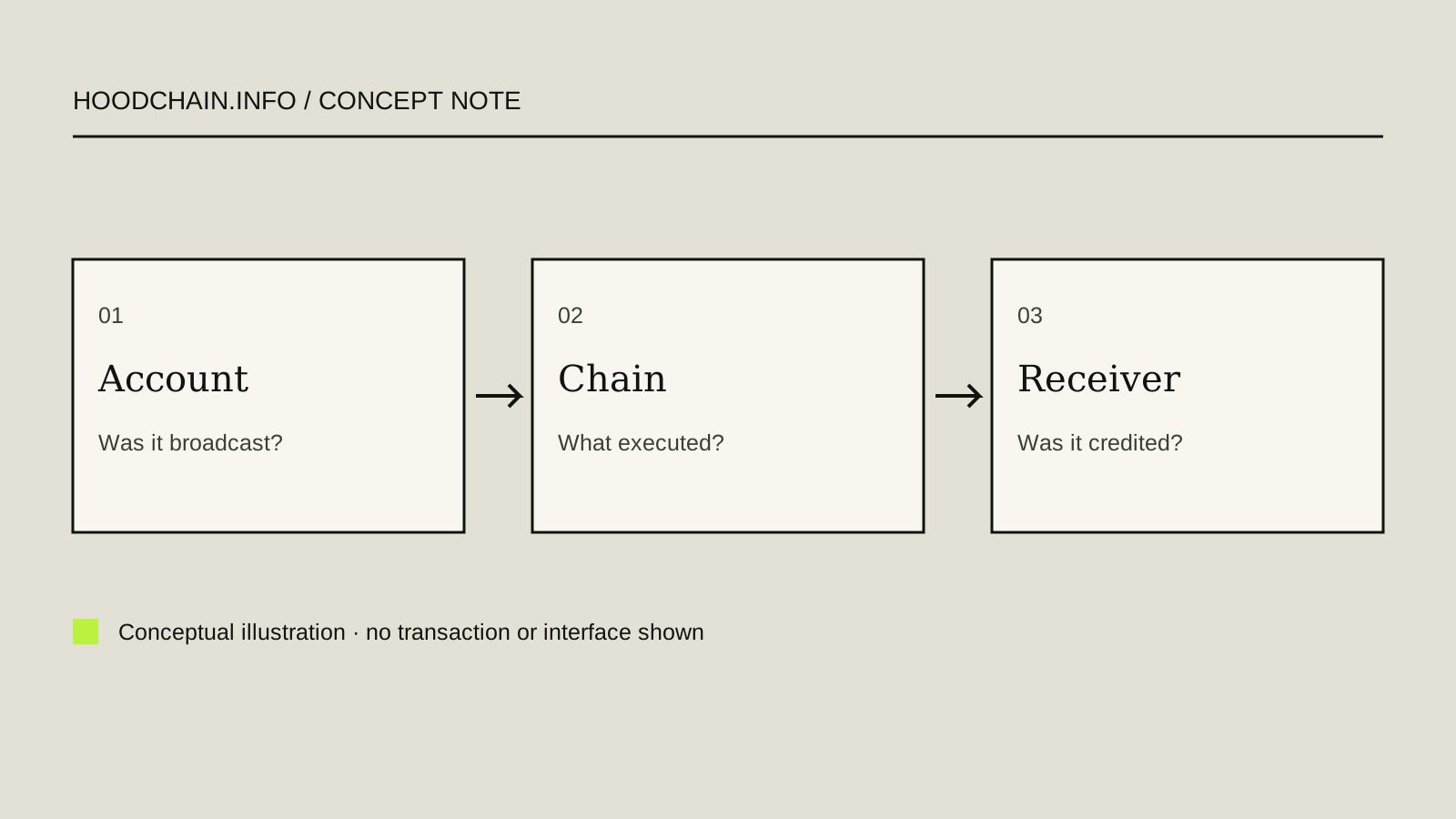
Find the system that currently has evidence
“Pending” can describe a provider request, an onchain transaction, or the receiver’s crediting process. Those states are not interchangeable. First ask: was a transaction broadcast, and which network can show it? An internal request ID is not necessarily a transaction hash.
This article explains diagnosis, not recovery or a way around a hold. Robinhood’s cited transfer procedure is for its US Crypto service. The current official UK support page, reviewed 26 October 2026, describes in-app crypto through Bitstamp UK Ltd and explicitly says external crypto deposits and withdrawals are unavailable for that UK service. This UK-specific rule does not describe US availability or establish rules for other regions. Confirm the named product and region in the official support source.
Stage 1 — provider request, before broadcast
A provider may show a request as pending, review, held or unavailable before it submits anything to a network. At this stage there may be no transaction hash. A request or order ID can help support locate the record, but searching an explorer without a hash cannot prove that funds moved or disappeared.
For the actual service, check the exact status text, available-to-send amount, asset/network selection and any account-specific restriction in its verified interface. Robinhood US support identifies transfer limits and review as service-side factors. A purchase balance does not prove the whole balance is currently transferable. Do not infer a release time from the word “pending.”
Cash deposit, buying power and transferable crypto are separate
For the dated US example, Robinhood describes buying power as money available for purchases. Some Instant Deposit funds may be usable for purchases before the bank transfer has fully cleared; the linked US settlement page says the bank transfer itself may take up to five business days. It also says crypto-sale proceeds are available immediately as buying power. Neither statement alone means cash is withdrawable or crypto is eligible to send.
The US Crypto transfers page separately says crypto withdrawal limits depend on factors such as verification and account activity, can change, and are visible in the service. It lists an uncleared bank deposit's instant funds and a reached daily transfer limit among possible reasons not all crypto can be withdrawn. A cash withdrawal to a bank and an onchain crypto transfer are different operations. Robinhood’s US cash-withdrawal help defines withdrawable cash separately and notes that account type and activity can affect exclusions; this is a US cash-account reference, not a crypto transfer-limit rule. Use the buying-power versus withdrawable-cash guide for the balance labels; then check the exact Crypto transfer screen for sendability. Separately, the same US Crypto transfer page says enabling transfers requires identity verification and may take up to five business days for review. That estimate is for enabling transfer access only; it is not the settlement time for a bank deposit, a withdrawal-limit reset, or a deadline for an individual account hold. These are US support statements, not a rule for other providers or regions.
Provider request ID is not a blockchain transaction hash
Fictional interface fixture P-01; no live account, transaction, destination or hash. The labels below are invented and non-operational.
| Displayed field | Fictional value | What it does and does not establish |
|---|---|---|
| Status | Under review | A provider-side status label; it does not identify a chain state or cause. |
| Provider request ID | DEMO-REQ-014 | An internal lookup reference, not an onchain transaction hash. |
| Network transaction hash | Not shown | No public hash is displayed in this fictional panel. That is not proof that no activity occurred. |
| Destination | Not shown | The destination cannot be verified from this panel. |
Answer: the only supported conclusion is that this example shows an under-review provider request. Ask the provider through its verified channel whether it was broadcast and whether a public hash exists. If none is supplied, do not manufacture one or claim that the network failed or that nothing happened. If a hash is later provided, confirm the exact network before using its explorer; an internal request ID cannot be searched as a transaction.
Robinhood's US Crypto help describes a transaction hash as the unique blockchain transaction identifier and links a block explorer after a transaction is sent. The EU page covers accounts with Robinhood Europe, UAB and Bitstamp Europe S.A.; its TFR review may request information in-app, and missing information may delay, cancel or prevent crediting. Neither provider request status is itself a hash.
Read the current limit or method notice; do not route around it
- Confirm the product, account provider and region shown in the official service. A help page for a different entity or country may describe a different transfer capability.
- Read the current screen's action, asset/network, available-to-transfer amount, limit period, payment/funding method and exact notice. Keep private account details inside the official app.
- In the dated US Crypto help, the page directs customers to Account → Menu → Crypto to view crypto transfer limits; it says withdrawal limits may vary with activity and can change daily. The page says limits cannot currently be manually increased. This is a time-stamped US help description, not a promise of a particular limit or reset time for an account.
- The EU Crypto transfers page covers both Robinhood Europe, UAB and Bitstamp Europe S.A. and directs users to Account → Transfer Crypto to view limits; pending TFR questions may require an in-app response. Follow the entity-specific current prompt; do not send documents through an unsolicited link.
- The current UK Bitstamp help says external crypto deposits and withdrawals to outside wallets are unavailable for that UK service. That is a product limitation, not an adjustable US-style withdrawal amount. Check the UK account's own official help for current supported actions.
Do not split a transfer, use another account or network, or otherwise bypass a limit or review. Do not infer a universal processing time. If a notice is unclear or conflicts with the service's current help, stop and ask that provider through its verified support path.
Stage 2 — broadcast and inclusion on the selected network
If the provider confirms that it broadcast the transaction, use the supplied hash with an explorer for the exact network. Check that the hash resolves, the asset and destination are the intended ones, and whether the transaction is absent, included, successful or reverted. A blank result can also mean the wrong network or an unavailable/indexing explorer; by itself it is inconclusive.
For Robinhood Chain specifically, its documentation distinguishes a sequencer’s soft confirmation, the batch posting to Ethereum, and Ethereum finality. A soft L2 receipt is not the same as Ethereum finality. Do not apply this three-stage sequence to unrelated networks.
A failed or reverted execution means the requested state change did not complete even though a network fee may be recorded. Read the receipt/error and the receiving service’s rules before drawing a conclusion. Do not repeat the action merely because it failed; the cause may persist.
If a transfer says failed, identify the stage before deciding what happened
- If the provider shows only a failed/pending request and no hash, keep the result provider-side and ask whether it was broadcast. A missing displayed hash is not proof that no transaction occurred.
- If a public hash is already supplied, match the network and asset, then inspect status, destination and execution/transfer events. A hash on the wrong chain is not evidence about the intended transfer.
- If the matching chain record shows execution reverted or the intended asset movement is absent, record that observed failure and any fee; do not guess its cause. If it shows success, distinguish execution from the receiver's crediting state.
- Before any new action, compare what the sender/provider and intended receiver currently show. Do not resend unless the responsible provider confirms the original state and gives the appropriate next step. Repeating an action can create a duplicate transfer or another fee.
For a missing balance, use the balance diagnosis. To interpret a receipt without sending anything, use the fictional block-explorer exercise. For product-specific availability, consult the regional product guide.
Stage 3 — receiving-service confirmations and credit
A successful transaction on the correct chain is evidence of execution at that destination, not proof that a custodial receiver has credited its account balance. The receiver may require its own asset/network confirmation threshold, account review or processing. Compare the public receipt with the receiver’s current deposit status and supported-network instructions.
Keep separate a normal transfer delay, a Robinhood Chain finality stage, and a bridge challenge period. The canonical Robinhood Chain bridge documents a withdrawal challenge period of about seven days. Separately, it describes manual redemption within seven days for a specific case: a canonical bridge deposit whose L2 execution failed because the transaction lacked sufficient gas. That exception is not a universal recovery promise or an instruction to make another transfer.
Fictional cases: classify before responding
All IDs and observations below are invented. They are not real transfers, hashes, accounts or addresses.
| Record | Evidence | Best classification |
|---|---|---|
| X-01 | Provider says “review”; only request ID is shown; no broadcast hash | Provider review shown; broadcast and network state unverified |
| X-02 | Fictional Robinhood Chain receipt shows sequencer soft confirmation; no Ethereum batch-finality evidence yet | Included at an L2 stage; Ethereum finality not established by this evidence |
| X-03 | Correct-network receipt says execution reverted; intended token movement absent; fee recorded | Included but failed execution; investigate error before any decision |
| X-04 | Correct-network execution succeeded; receiver page still says its confirmations are pending | Onchain execution succeeded; receiver credit remains pending |
Show the answer key
- X-01: no hash means do not claim an onchain failure. Check the provider’s stated hold/review and ask whether broadcast occurred.
- X-02: a sequencer response is not evidence that Ethereum finality occurred. Check the next stage only through documentation or a matching-network record.
- X-03: the intended movement failed at execution. A fee can still be recorded; the case does not identify the cause or prove that retrying would work.
- X-04: execution and receiver credit are separate. Follow the receiver’s published confirmation process; no arrival deadline is inferred.
When a hash, balance or status is missing
Ask the named provider whether broadcast occurred and whether it can supply the public hash. If there is a hash, confirm the exact network before consulting an explorer. If the network shows success but the receiver does not show credit, compare the intended token, network, destination/account and receiver policy. A token may not appear in every wallet interface automatically; that display issue is not itself proof of loss.
For Robinhood Chain, the fictional explorer exercise explains which receipt fields answer which questions. For a pre-send network check, use the asset and network checklist. Neither guide performs a live check.
Escalate with clear, non-secret evidence
A concise support note can name the product and region, asset, source and destination networks, request time, request ID, public hash if one exists, displayed status and the exact unresolved question. Use the verified support path for private account details. Never share a recovery phrase, private key, password or one-time login code in a public message or with someone offering recovery.
No fictional case gives a processing deadline or guarantees recovery. A provider status may remain uncertain until the relevant service confirms it. State what is known, what is not known and which party can verify the next stage.