
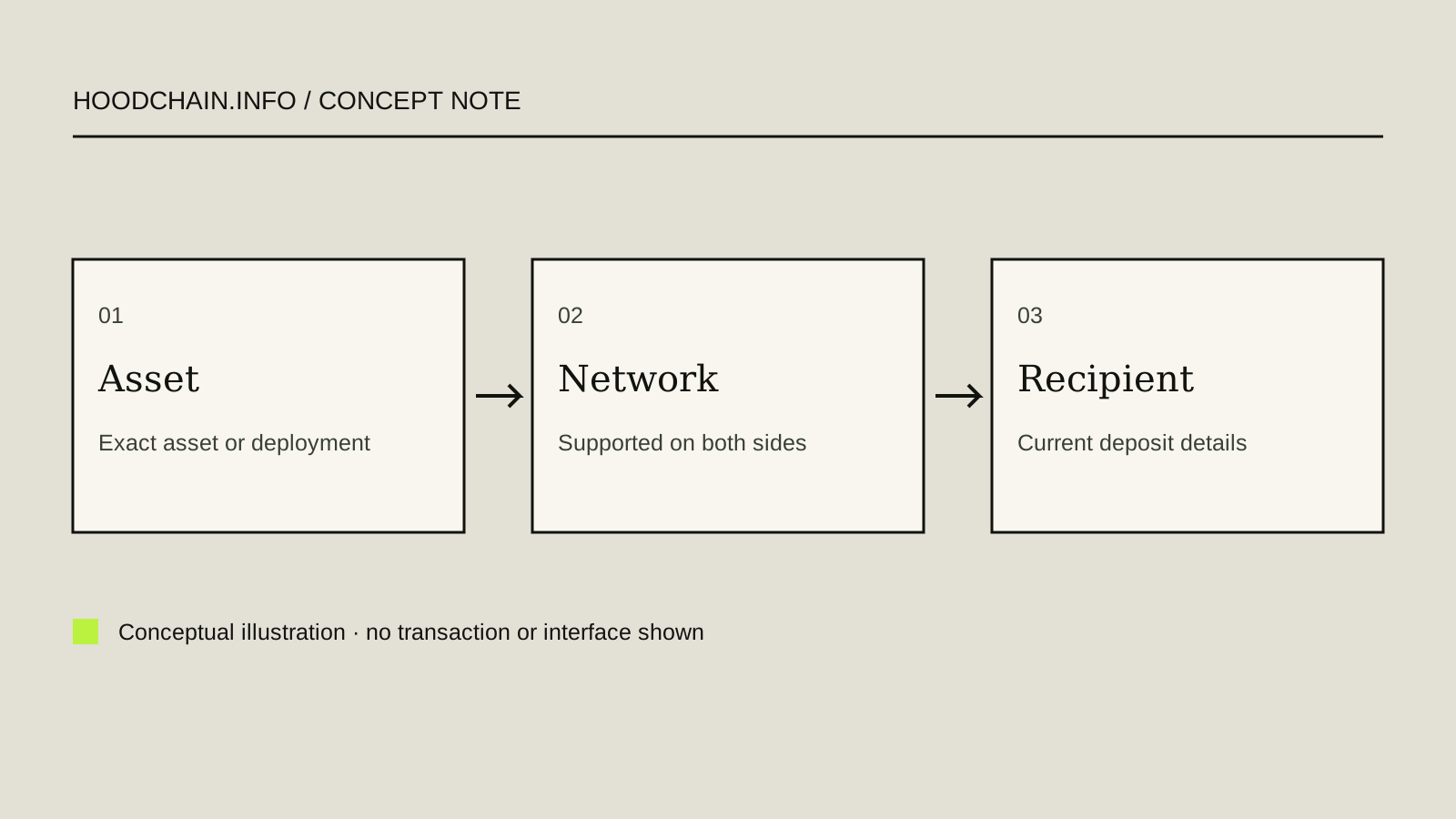
Match asset, network and recipient
A custodial crypto transfer has three independent coordinates. The asset identifies what moves. The network identifies where it moves. The recipient identifies who or what receives it. A valid address format does not prove all three match.
Use the sending product’s current asset/network selector and the receiver’s current deposit instructions. If either side does not support the same pair, stop. Buying an asset inside an account is not evidence that it can be withdrawn over every network where a similarly named token exists.
Get the address from the receiving product
For a deposit into a custodial service, use the address and any memo or tag displayed by that service for your account and selected asset. Do not return funds to the sending address seen in a previous withdrawal transaction. A provider may use shared or operational sending addresses that are not your deposit destination.
Compare the complete destination after pasting. Saved nicknames and truncated address previews are conveniences, not independent verification.
Availability is narrower than a brand name
The US transfer documentation reviewed for this lesson lists network-specific support and restrictions. Your account, location, asset and current product screen determine whether a particular route is enabled. US instructions cannot establish another market’s eligibility.
Do not infer that a supported EVM address means support for any EVM chain. A receiving service can recognize the address syntax while not crediting deposits on the chosen network.
Separate processing states
- Requested: the service has accepted a request, but there may be no broadcast hash yet.
- Broadcast: a transaction has been submitted to the chosen network.
- Executed: the chain receipt describes success or failure.
- Credited: the receiving service has completed its own processing.
A successful chain receipt does not override a receiver’s support rules or prove account credit. If the destination is missing, collect the public hash, network and receiving-service status before asking that service’s official support. Never include a recovery phrase.
Worked example: the same-looking address
A learner sees an address beginning with 0x in a receiving service. The sender offers several EVM networks. The learner must check which network the receiver supports; the address prefix does not make that choice. Selecting the cheapest option without support evidence can result in an uncredited or unrecoverable deposit.
This is a decision example, not an executed transfer. Any minimums, fees or holds must be read in the actual product.