
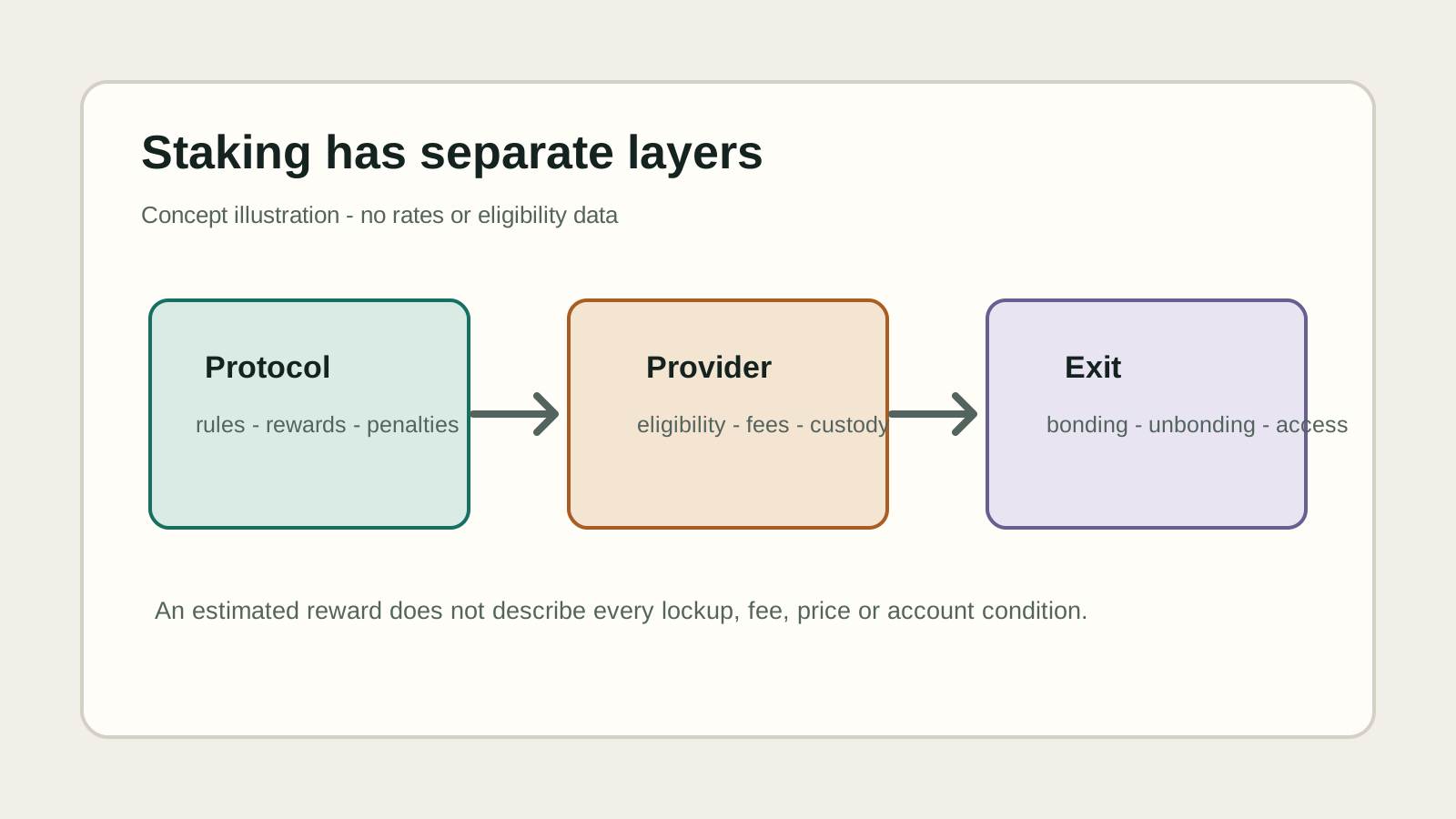
Staking is a protocol activity, not a generic yield label
Proof-of-stake staking commits a network’s native asset to help run consensus under that protocol’s rules. On Ethereum, staking ETH activates a validator; validators propose and attest to blocks, and protocol penalties can include lost rewards or slashing for provable misbehavior. Provider-mediated staking can add a custodian or service partner between a customer and the protocol.
Do not treat staking as interchangeable with an AMM liquidity-pool deposit, a loan, a money-market fund or bank interest. Each has a different asset claim, counterparty, pricing and exit mechanism. A displayed reward estimate is not a guaranteed return, and a token-price move can outweigh rewards. A promotional reward is a provider offer governed by campaign terms; it is not automatically protocol staking yield.
An Ethereum liquid-staking token (LST) is another distinct case: the token is a claim on a pool or smart contract staking on a holder’s behalf, rather than the protocol stake itself. It can add contract, operator, governance, liquidity and depeg risks. A sellable receipt token does not mean the underlying ETH has finished unbonding or that redemption is immediate.
Separate the provider, the protocol and the account
When a brokerage or crypto provider offers a staking feature, the screen describes that provider’s service for specified assets and accounts; it does not make every asset or network stakeable. The protocol defines validator rules, reward variability, bonding and unbonding. A provider or staking partner can add fees, custody and processing steps.
For Robinhood Crypto, the US and EU support pages reviewed 26 October 2026 describe estimated, variable protocol rates and rewards after applicable fees. They also warn that an asset may be locked during bonding or unbonding and that protocol penalties can reduce staked assets. Exact eligible assets, fee calculations, account requirements and timing depend on the specific region, asset and current terms. This guide records documentation only; no account or staking status was checked.
Robinhood Chain is a network and Robinhood Crypto is a separate provider service. The cited support pages do not establish that an account can stake assets on Robinhood Chain. Do not infer a feature from a token, ticker, network or marketing label.
Dated product scope: US, EU and UK are not one service
| Product scope | What the cited source says | What it does not establish |
|---|---|---|
| US Robinhood Crypto | The US staking help page describes crypto staking and currently lists California, Maryland, New Jersey and Wisconsin as states where staking is unavailable. It lists supported assets and account-related exclusions on the live help page. | Not a determination for every state, person, asset or account. Check the current in-app feature and applicable disclosures; the dated list may change. |
| Robinhood Europe Crypto | The EU staking page describes staking features for EU accounts and expressly says staking is not available for Bitstamp customers who recently moved their accounts to the Robinhood app. | Not a complete country or migration-cohort matrix; do not infer eligibility from another Robinhood Europe account or a visible crypto balance. |
| Bitstamp UK through Robinhood | The cited UK page describes crypto trading through Bitstamp UK Ltd and its onboarding terms. It does not establish a UK staking feature. | Trading availability is not staking availability. No UK staking claim is made here; consult current UK product-specific support. |
Read the reward and the exit conditions together
- Variable rewards: protocol activity and rules can change estimates; rewards are paid in crypto, so their fiat value can fall.
- Bonding and unbonding: assets may become unavailable to sell or transfer; exit time is specific to the asset and protocol, not a universal clock.
- Protocol penalties: some proof-of-stake protocols penalize validator faults or misbehavior. A provider’s use of a partner does not remove protocol risk.
- Fees and custody: provider and partner charges reduce rewards, and a provider-mediated service adds provider and operational exposure. Read the current fee preview and agreement for the exact product.
- Concentration and price: reward tokens are still volatile assets; rewards do not neutralize market loss or concentration.
An APR/APY estimate alone omits fees, lockup, price changes, validator rules and counterparty exposure. Do not compare rates until the asset, calculation period, fee basis, compounding assumption and unstaking access match.
Fictional eligibility check
Paper example S-03: a fictional customer can see and trade crypto in a Robinhood-branded app. The profile says the account recently migrated from Bitstamp Europe, and the customer assumes that trading access means staking access.
Show the answer key
That inference is unsupported. The EU staking help page reviewed 26 October 2026 explicitly says staking is unavailable for recently migrated Bitstamp customers. Check the exact account cohort and current official support instructions; do not transfer assets, connect a wallet or submit a staking request to test eligibility. The UK trading page is not evidence of UK staking, and the US staking page does not determine EU eligibility.
A read-only checklist
- Match the product and legal provider to the account’s current terms.
- Check current country/state, migration cohort and asset eligibility in the official help channel.
- Read estimated protocol rate, provider/partner fees, payout form and effective date in the current disclosure.
- Find bonding, cancellation, unstaking and unbonding conditions before treating the asset as liquid.
- Consider protocol penalties, provider/custody risk, token price volatility and tax treatment that depends on your circumstances.
- If a field or eligibility rule is unclear, stop and ask the provider. Do not rely on a copied rate or social post.
This lesson is educational, not financial or tax advice. No rate is quoted, no account was checked and no stake or unstake was submitted.
Continue with liquidity pools and other yield mechanisms or crypto risks.