
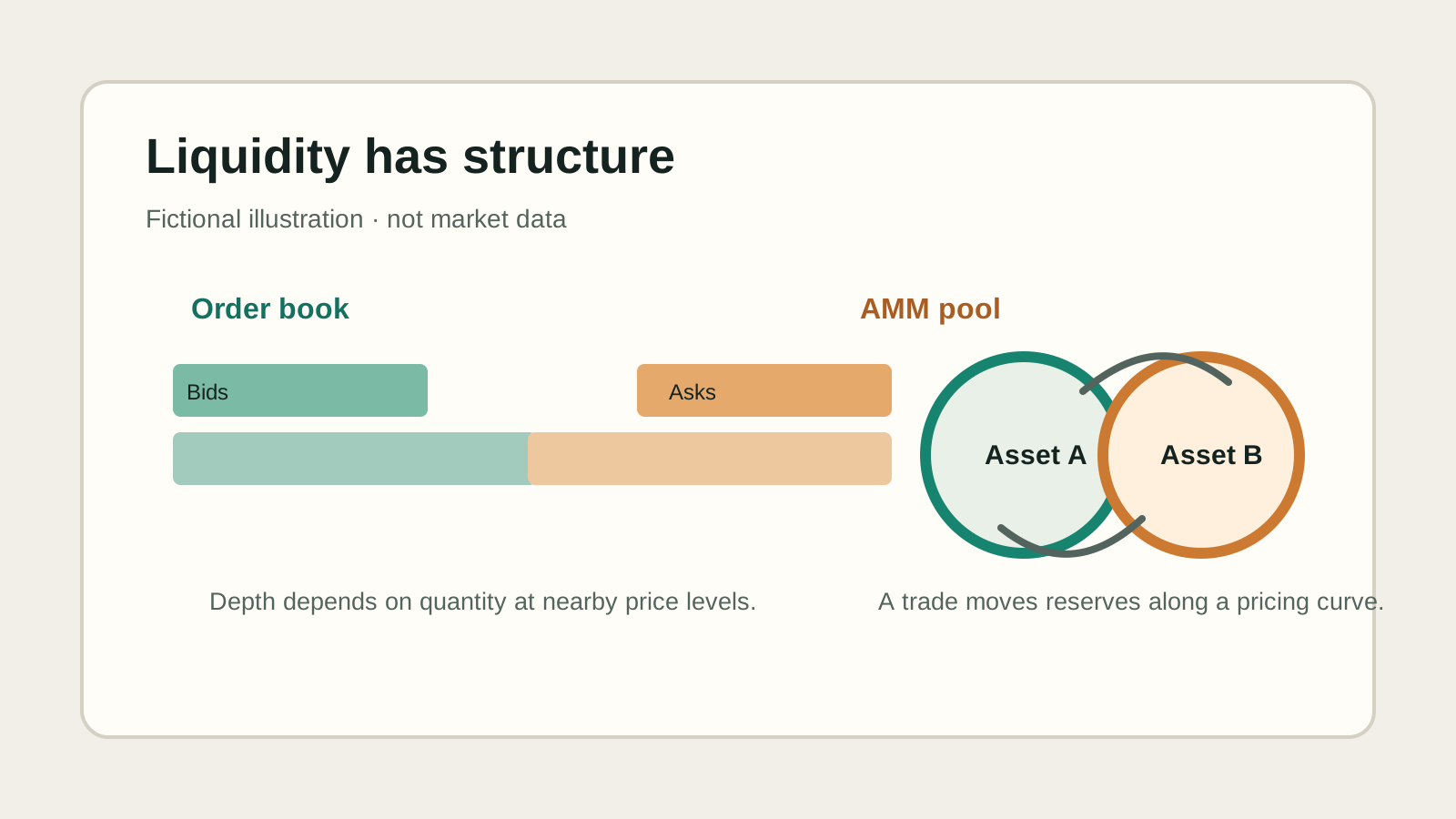
Quick distinction: a price quote is not liquidity
Price is a quote for one unit under a particular market and time. Reported market capitalization multiplies a quoted price by a stated supply measure; it is not cash invested or the amount that could be sold at that price. Volume counts past trading over a period. Depth describes how much can be traded near current quotes before the price changes materially. An AMM pool is a separate trading mechanism whose reserves and pricing curve shape execution.
Liquidity for trading is not the same as financing or lending. A loan supplies capital under repayment terms; market liquidity describes how easily an asset can be exchanged. Joining a pool makes assets available under a protocol’s rules and exposes the position to price and contract risks. This lesson is general. It does not establish that any pool, dApp or liquidity-provider feature exists on Robinhood Chain or is available in a Robinhood account.
Price and reported capitalization answer different questions
For listed companies, Investor.gov defines market capitalization as share price multiplied by outstanding shares. As a publisher-specific crypto example, CoinMarketCap describes its market-cap figure as current price × circulating supply. That explains CoinMarketCap’s stated method; other publishers can define supply differently. It is a reported calculation, not an authoritative valuation, cash invested or the amount that could be sold at that price. The fictional calculation below uses only the stated example method.
Fictional example: suppose a data page says a token is $2 and states that its circulating-supply estimate is 10 million units. Using that page’s stated method gives a reported figure of $20 million. That arithmetic says nothing about how much could be sold near $2; for that, inspect available bids or the pool’s reserves and curve.
Volume, depth and spread: read the market around a trade
Volume is historical activity over a chosen window. It may be concentrated in a short interval, venue or small number of trades. Depth asks what executable buy or sell interest is available near a quote. In an order book, bids are buy offers and asks are sell offers. The midpoint is (best bid + best ask) ÷ 2; the spread is best ask − best bid. A wider spread can increase the cost of crossing from one side to the other, while a large market order can consume multiple price levels. A market order does not guarantee its displayed midpoint or last-traded price.
| Best bid | Best ask | Midpoint | Spread | Spread as share of midpoint |
|---|---|---|---|---|
| $99.90 | $100.10 | $100.00 | $0.20 | 0.20% |
Answer: midpoint = (99.90 + 100.10) ÷ 2 = $100.00; spread = 100.10 − 99.90 = $0.20; relative spread = 0.20 ÷ 100 × 100 = 0.20%. A separate depth table would still be needed to estimate how much is offered at nearby prices. Volume alone cannot supply that answer. These fictional quotes are not a live or Robinhood market.
For an AMM there may be no bid/ask order book. A trade changes pool reserves along the pricing curve, so trade size relative to reserves affects price impact. The quoted spot price is not a promise that a larger trade will execute at that price.
Market liquidity versus funding liquidity
Market liquidity asks whether an asset can be bought or sold with relative ease and without a major price change. A quote alone does not show how much can trade near it; available orders or pool depth matter. Funding liquidity asks whether cash or arranged funding is available to meet obligations when due. Federal Reserve interagency guidance describes institutional liquidity as the capacity to meet cash and collateral obligations at reasonable cost, and describes market liquidity in terms of converting assets into cash or accessing funds. The household example below is only a teaching analogy, not a direct application of institutional supervision rules.
Fictional contrast: a screen quotes an asset at $100, but only $100 of nearby bids are available. That does not show that $1,000 can be sold at the quoted price; a larger sale could consume bids at lower prices or find no buyer at that level. Separately, someone has a $500 cash obligation due today, $300 of available cash and an asset worth $1,000. The valuable asset is not automatically cash or funding available by the due time. These invented numbers illustrate different questions; they describe no real market, account or household.
What an AMM liquidity provider does
Liquidity, volume and pool mechanics
An automated market maker (AMM) uses a pool of assets and a pricing rule rather than matching a buyer with a specific resting sell order. A liquidity provider (LP) contributes assets to a pool position so traders can swap against it. The position can earn a share of trading fees under the pool’s rules, but fees vary with actual activity and the position’s eligibility. Incentive rewards, when a protocol offers them, are separate from swap fees and can change or stop.
Different AMMs and versions have different rules. Uniswap v2 uses a constant-product model; v3/v4 allow concentrated ranges and use different position/fee mechanics. In the idealized v2-style model below, reserves x and y satisfy x × y = k; the marginal quote for A in units of S is y/x. An external price quote by itself does not change pool reserves. In the simplified no-fee equilibrium example, swaps/arbitrage against the outside market move reserves along the curve until that marginal price matches the external price. The calculation below is only an idealized, full-range, 50/50 constant-product v2-style teaching example. It does not apply to concentrated positions, weighted pools, stable-swap curves, real execution or any stated Robinhood product.
Do not confuse an AMM liquidity-provider position with Ethereum staking. Ethereum.org describes ETH staking as depositing ETH to activate validators in Ethereum consensus, with possible penalties including slashing. An AMM LP instead supplies a pair of assets to swap reserves and may receive protocol-defined swap fees. If an app separately offers staking an LP token for an incentive, that is another step with its own rules and risks; it does not turn LP participation into Ethereum validator staking. No such feature or availability is asserted for Robinhood Chain or a Robinhood account.
Solved fictional pool example: relative divergence and absolute result
Invented inputs: an LP contributes 5 units of asset A at $100 each and 500 units of asset S at $1 each. Starting value is $1,000. Assume a full-range 50/50 constant-product pool, S stays at $1, A rises to $200, and ignore fees, gas, incentives, taxes, slippage and all other costs. The comparison is against simply holding the original 5 A and 500 S.
- Start with reserves
x = 5 Aandy = 500 S, sok = x × y = 2,500 A·Sand the initial marginal price isy/x = 100 S per A. A rises to an outside price of $200 while S stays at $1. The quote alone does not alter reserves. - In the idealized no-fee model, swaps/arbitrage move reserves until
y/x = 200whilex × y = 2,500. Solving gives200x² = 2,500, sox = √12.5 ≈ 3.5355 Aandy = 200x ≈ 707.1068 S. - LP position value is about
(3.5355 x $200) + (707.1068 x $1) = $1,414.21. - Holding the starting tokens would be
(5 x $200) + (500 x $1) = $1,500. - Relative divergence versus holding is
2√r / (1 + r) - 1; forr = 2,2√2 / 3 - 1 ≈ -5.7191%. Yet the modeled LP value is still $414.21 above the $1,000 start, a 41.42% absolute gain before costs.
“Impermanent loss” is commonly used for that relative divergence versus holding; it does not mean the position must show an absolute loss. It may not reverse before exit. Fees can offset divergence, but they are uncertain and must be netted against gas and other costs. For illustration only, if the position separately earned $100 of incremental fees not already included in the base model and paid $15 of additional costs, its result would be $1,499.21—still $0.79 below the $1,500 hold comparison.
If both assets instead fell 50% while their relative price stayed unchanged, this idealized pool would have zero divergence versus holding, but both the LP and HODL values would be $500: a 50% absolute loss. Zero relative divergence does not mean no risk.
Concentrated ranges and displayed yields add assumptions
In concentrated-liquidity designs such as Uniswap v3/v4, an LP selects a price range. A position outside its active range can become entirely one asset and stop earning swap fees until price returns to the range or the position is adjusted. This is not the same as a simple full-range v2 position; do not reuse the formula above for it.
A displayed APR is a simple annualized rate convention; APY includes the assumed effect of compounding. For a purely mathematical illustration, 12% APR compounded monthly with no costs gives (1 + 0.12 ÷ 12)12 − 1 ≈ 12.6825% APY. That arithmetic is not a pool quote or offer. Protocol dashboards may use changing volume, fees, emissions, token prices, eligibility or reinvestment assumptions; a displayed rate is not guaranteed net return.
Pool benefits and risks to check before evaluating a position
| Potential benefit | Matching risk or limit |
|---|---|
| Swap fees may accrue to an eligible position | Fees depend on actual volume, fee tier, competing liquidity, active range and pool rules; net fees may not cover divergence or costs |
| Assets are made available for traders through the pool | The LP gives up immediate control over the deposited mix and can withdraw only under the protocol’s mechanics and network conditions |
| Concentrated ranges can target capital within a chosen interval | Outside the interval a position may be single-sided and earn no swap fees; adjusting can add gas and execution costs |
| Incentives may add rewards where a protocol explicitly offers them | Rewards can fluctuate or end, may have volatile value, and can obscure the difference between fees and token emissions |
Also check the exact contract and version, admin or upgrade powers, token depeg and reserve quality, any oracle or bridge dependencies, transaction-ordering/MEV exposure, network fees, withdrawal conditions and the route needed to exit. Each design differs; this page did not audit a contract, oracle, bridge, pool or provider.
Before assessing any specific pool, verify its network, contracts, asset pair, fee rules, range, withdrawal path and official documentation from independent primary sources. Do not connect a wallet or deposit funds just to answer an educational question. No pool availability on Robinhood Chain or for a Robinhood product is asserted here.