
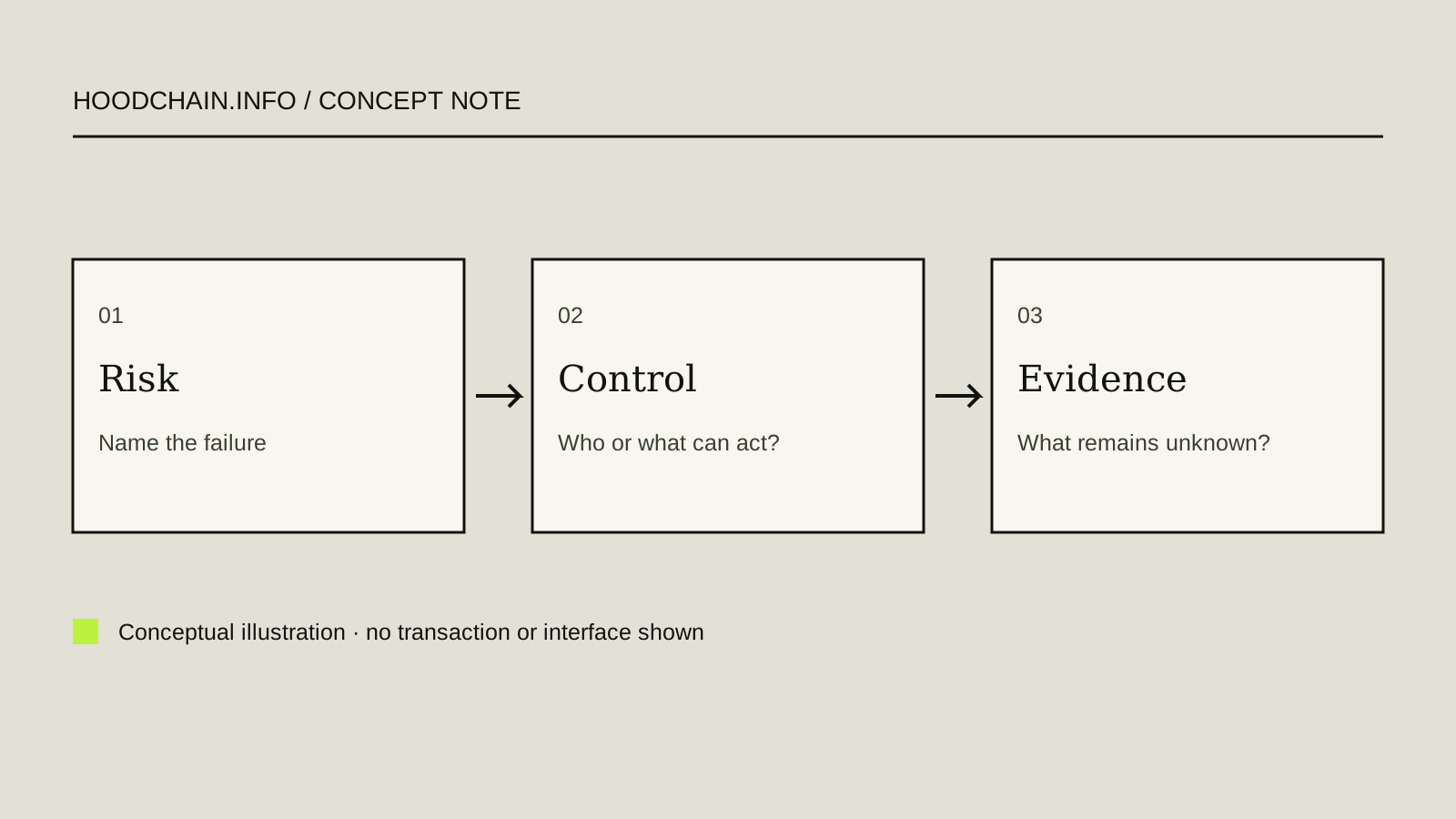
Name the failure before choosing a safeguard
“Is crypto safe?” hides several different questions. An asset can lose market value while every app works; a provider can restrict an account; a wallet key can be exposed; a network or contract can fail; or a fraudster can impersonate support. One control does not cover every failure.
This guide maps those risks and distinguishes price loss from the narrow scope of insurance or investor-protection arrangements. It is documentation-based education, not a safety score or a promise that any action is safe.
Five risk families and the evidence to check
- Market price and liquidity
- A token or coin can fall sharply or become difficult to sell at a quoted price. A stablecoin can depart from its reference. Login security, custody and insurance do not guarantee value or an exit price.
- Custody and account access
- A custodial provider controls keys and may apply account controls; a self-custody user controls signing authority and carries backup and device risks. An account password or app balance is not necessarily a blockchain private key.
- Counterparty and legal rights
- An issuer, custodian, exchange, bank, bridge or other intermediary may fail, delay service or not meet an obligation. Identify the legal entity, the product terms, and what claim or recourse the source actually describes.
- Technology and operations
- Wallet software, RPC services, smart contracts, bridges, sequencers, devices and network upgrades can be unavailable or behave unexpectedly. A display error alone does not prove that an asset moved or disappeared.
- Fraud and manipulation
- Impersonators can copy a brand or ticker, invent urgency, request recovery material, or trick a user into granting permissions. A familiar logo, verified-looking profile, audit label or successful login is not proof that a request is legitimate.
Several categories can occur together. For example, a phishing message may target a self-custody key while a separate market move changes the asset’s price.
Protection and insurance answer narrower questions
Market loss is a different problem from missing assets after a covered firm failure. SIPC describes its US role as restoring eligible customer cash or securities missing when a SIPC-member broker enters liquidation; it does not cover a fall in market value. SIPC also says it does not protect crypto assets that do not qualify as securities under the applicable law.
For the United States product scope, Robinhood’s current support disclosure says crypto held through Robinhood Crypto, LLC is not FDIC-insured or protected by SIPC. FDIC deposit insurance concerns eligible deposits at insured banks; it is not protection against a crypto issuer, custodian or token losing value. The same Robinhood disclosure describes certain separate cash programs that may qualify for pass-through FDIC insurance under their own conditions. That does not make a crypto position an insured deposit.
Do not carry those US protection statements into other countries or products. For UK Bitstamp by Robinhood, Robinhood identifies Bitstamp UK Ltd as the crypto-asset and custodian-wallet provider and says crypto held through it is not protected by the UK Financial Services Compensation Scheme (FSCS). That is a UK-specific statement, not a US or EEA rule.
For European accounts, Robinhood’s transfer support identifies customer wallets controlled by Robinhood Europe, UAB or Bitstamp Europe S.A., depending on the account, and says customers do not receive the private keys. The cited page describes custody and transfers; it does not establish an investor-compensation guarantee. Check the current legal entity and account terms rather than inferring a protection scheme.
None of these arrangements prevents price decline, fraud, transfer mistakes or every provider, legal or technology failure. Eligibility, account type and rules matter; this page does not determine a reader’s claim or protection.
Compare financial risks by what can fail
Risk labels describe different possible losses; they do not predict a return or say how likely an outcome is. For crypto, a market-price move can happen without an app, custodian or network failure. For a bond or other financial holding, additional risks can arise from the issuer, trading market, currency exposure or how holdings overlap. These categories can overlap, and a diversified portfolio can still lose value.
- Price volatility, unrealized and realized loss
- Volatility describes how much and how quickly a quoted market price changes. A quote below a position’s cost basis can represent a simplified unrealized loss while held; selling below that basis realizes a loss before any applicable fees or tax treatment. A market move alone does not tell you the executable sale price.
- Credit risk
- For a debt investment such as a bond, credit risk is the possibility that the issuer will not make interest or principal payments on time. A crypto token is not automatically a debt claim, so do not assume a token holder has a bondholder’s repayment right.
- Liquidity risk
- Liquidity risk is difficulty selling when desired, or needing to accept a price concession because buyers or market depth are limited. A displayed price or recent trading volume does not guarantee that a position can be sold at that price or size.
- Currency risk
- When an investment or its underlying business has exposure to a foreign currency, exchange-rate changes can raise or lower the result measured in your home currency, even if the asset’s local-currency price is unchanged.
- Concentration risk
- Several holdings can depend on the same issuer, sector, market driver or intermediary. Counting tickers is not enough: overlapping holdings can leave exposures concentrated. Diversification may reduce some concentration risk, but cannot eliminate loss or guarantee a result.
Fictional drawdown calculation
Invented numbers; no asset, account or performance was tested. Drawdown measures a decline from a prior peak to a later trough: (peak value − trough value) ÷ peak value × 100. If a hypothetical portfolio peaks at $10,000 and later reaches $7,500, its peak-to-trough drawdown is ($10,000 − $7,500) ÷ $10,000 × 100 = 25%. This describes that past path only; it does not predict recovery, future loss or return.
FINRA’s investor education discusses market, currency, liquidity and concentration risks; Investor.gov’s bond FAQ describes credit, interest-rate, inflation and liquidity risks for bonds, while its diversification page explains that spreading holdings may reduce risk. Those sources address general financial education and US investor context; they do not classify a particular crypto asset, account or portfolio. See the dated FINRA risk overview, FINRA currency-risk explanation, Investor.gov bond FAQ, and Investor.gov diversification overview.
This comparison is educational, not a recommendation to buy, hold, sell, diversify or accept a particular risk.
Fictional exercise R-01: classify the problem
All names and events below are invented. No account, wallet, funds, claim or transaction was tested. Alex sees four things: (1) a crypto price display falls from $100 to $60 while the app still opens; (2) a stranger claiming to be support asks Alex to type a recovery phrase into a site; (3) a US Robinhood Crypto balance appears as an account position; (4) a UK Bitstamp by Robinhood customer asks whether the cited US SIPC statement decides their UK crypto protection.
For each, name the primary risk, the fact that can be checked from the cited source, and what the evidence does not prove.
Show the answer key
- Price and liquidity risk. The displayed price change is not an app-access failure and not an insurance claim. It says nothing by itself about the executable price or the future value.
- Fraud and custody risk. Never give a recovery phrase to a requester or enter it into a site supplied by someone else. The exercise does not involve revealing or using any phrase.
- Product-specific protection boundary. The US Robinhood disclosure says its Crypto holdings are not FDIC-insured or protected by SIPC. That does not establish the treatment of a separate brokerage security or eligible cash program.
- Jurisdiction mismatch. The US statement does not decide the UK question. Robinhood’s UK page separately says Bitstamp UK crypto holdings are not FSCS-protected. Check the account’s current entity and terms; neither statement guarantees a holder’s outcome.
A response checklist cannot make an action risk-free
- Identify the asset, network, account or wallet, provider and legal entity involved.
- Separate a price change from account access, transaction inclusion, custody and legal-protection questions.
- Use a source that matches the product and country, and note its date and stated limits.
- Do not share a password, recovery phrase or private key with support or anyone else. Stop if a message asks you to disclose one.
- For an unresolved account or protection question, use the provider’s official support path; do not assume a failed display means funds are gone or that insurance applies.
A checklist can help identify missing evidence. It cannot guarantee security, recovery, compensation or financial performance.
Continue with custody and recovery, or return to the Robinhood product map.