
Start with rights and structure, not a ticker
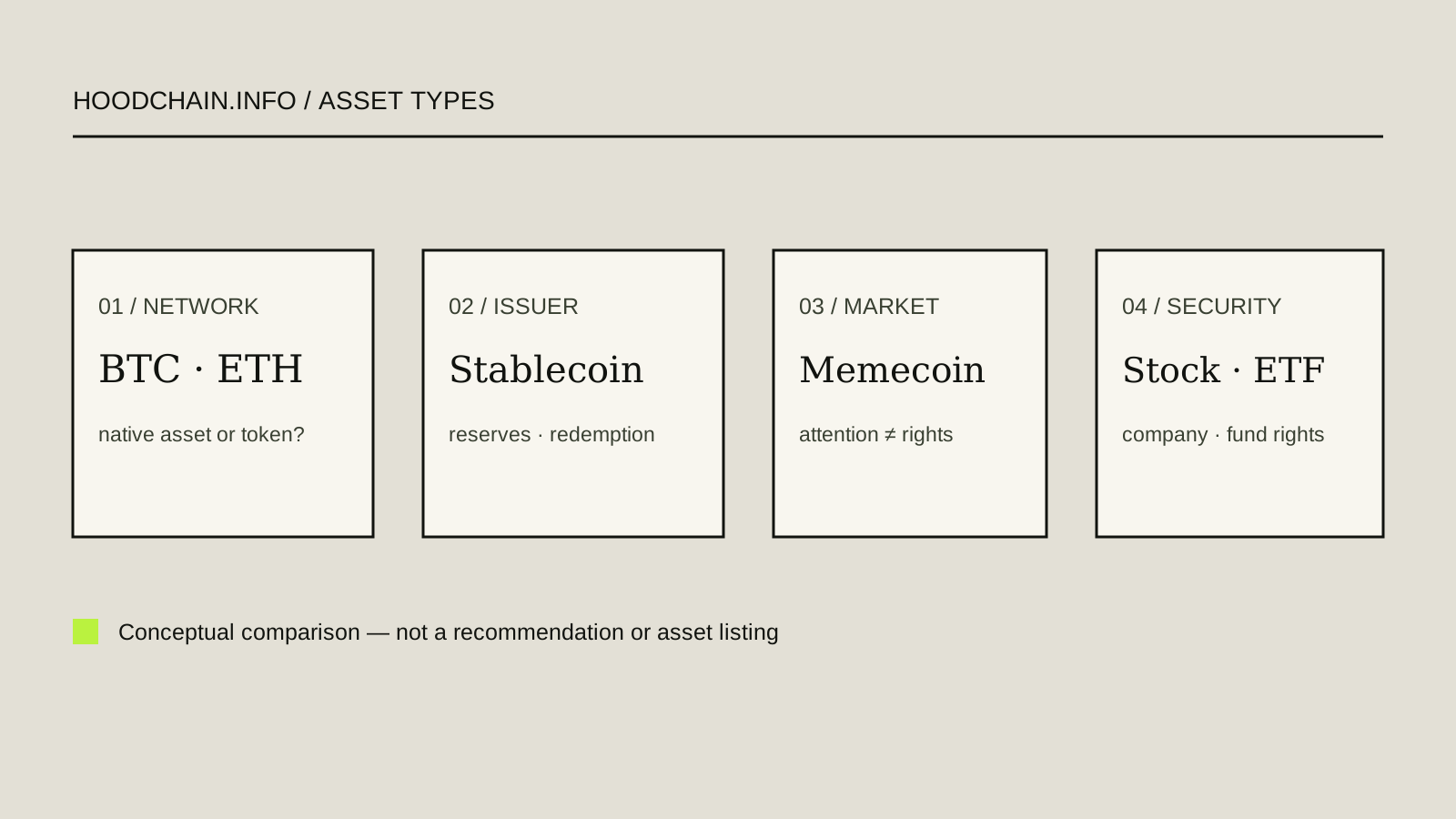
Bitcoin, ETH, a stablecoin, a memecoin, a stock and an ETF share are different kinds of assets. A name or dollar-like display does not tell you who issues it, what rights it carries, which network it uses, whether it can be redeemed, or who controls the keys.
This lesson explains categories, not what to buy. It does not establish that Robinhood or Robinhood Chain supports any asset discussed here. Check the specific provider, account, region, network and contract before relying on availability.
Bitcoin: BTC and the Bitcoin network
Bitcoin is the name commonly used for the peer-to-peer network and protocol; bitcoin (BTC) is the native asset recorded by that network. The original Bitcoin paper describes a peer-to-peer electronic cash system. BTC is not a share in a company and does not automatically give its holder a claim on a promoter’s profits, reserves or assets.
A BTC balance displayed by a custodial provider is an account record; it does not by itself mean the user holds the network’s signing keys. In self-custody, key control and recovery are separate responsibilities. A BTC ticker on a different network may refer to a wrapped or bridged representation, so check the network and asset representation rather than relying on a symbol.
Ethereum is the network; Ether (ETH) is its native asset
Ethereum is a blockchain network and execution environment. Ether (ETH) is its native cryptocurrency. Ethereum’s documentation identifies ETH as the asset used to pay gas on Ethereum and to participate in proof-of-stake consensus.
ETH differs from an ERC-20 token: ERC-20 is a token standard for assets issued by smart contracts on Ethereum. A token can use ETH as its ticker or name without being native ETH. Wrapped ETH (WETH), for example, is a separate ERC-20 representation governed by a contract; it is not the same onchain asset entry as native ETH.
Network context matters. Robinhood Chain’s documentation describes it as an Arbitrum Layer 2 built on Ethereum and says ETH is its native gas token. That identifies the network’s gas asset; it does not make an ETH balance on Ethereum mainnet and one on another network interchangeable. Read the Chain overview and the deeper Ethereum compatibility guide.
Stablecoins: a reference target is not a guarantee
A stablecoin is designed to track a reference, often a currency such as USD. Designs differ. Some use reserves; others have used mechanisms such as algorithms that change supply. A peg can deviate. Reserves can face liquidity or custody problems, and operational, issuer, legal, banking, network or smart-contract failures can interrupt transfers or redemption.
Do not assume every holder can exchange one token directly for one dollar. Issuer terms may limit direct redemption to eligible account holders, set conditions or fees, and require a supported network. Circle’s USDC Terms, last updated 15 October 2026, explicitly apply only to holders located outside the European Economic Area (EEA). For that outside-EEA scope, the Terms say only User Type A holders with a registered Circle Mint account can redeem directly with Circle, subject to conditions and restrictions. Do not apply that document’s direct-redemption terms to EEA holders.
For USDC holders located in the EEA, Circle publishes a separate MiCA USDC White Paper naming Circle Internet Financial Europe SAS (Circle SAS) as issuer and describing a redemption right at par subject to applicable conditions. Its separate MiCA Redemption Policy sets out the EEA redemption process and conditions. Check those current documents for the relevant holder, issuer and chain; this example does not guarantee a particular holder’s redemption or generalize to other stablecoins, regions or issuers.
Before treating a stablecoin like cash, identify its issuer, reserve or stability design, redemption eligibility and process, applicable chain, fees, and what happens if the peg or redemption route fails. A token designed to track USD remains a crypto asset; it is not automatically a bank deposit or insured cash balance.
Memecoins: attention can outrun evidence
Memecoins are crypto assets associated with memes, characters, trends or online communities. A 2025 SEC Division of Corporation Finance staff statement describes certain memecoins as typically driven by market demand and speculation, with limited or no functionality and significant price volatility. That statement reflects staff views about the described type; it is not a rule, does not decide every token’s legal status, and does not protect buyers from other kinds of fraud.
Check who created the token, whether supply is concentrated, who can mint, freeze or change contracts, whether liquidity is thin or controlled, and whether project claims have evidence. A popular ticker, joke, celebrity mention, audit badge or active chat does not establish fair distribution, safe code, redeemable value or future demand. A holder can lose most or all of the amount put at risk.
Stocks and ETFs are not crypto tokens
A common stock is a security representing an ownership interest in a company; actual voting, dividend and other rights depend on the share class and governing documents. An ETF share represents an interest in the fund’s portfolio, not direct ownership of each underlying holding in the same way as a direct share. The fund’s structure, holdings, expenses, market price and risks are described in its prospectus and reports.
A crypto asset does not automatically convey ownership in a company, voting rights, a share of profits, a redemption claim or a legal claim on a reserve. A tokenized asset can have product-specific rights, but those must come from its legal terms and issuer; a ticker or resemblance to a stock does not create the rights of a direct share. Read the separate Stock Tokens guide for that product-specific distinction.
Other asset labels differ too: Investor.gov defines a bond as a debt security through which an issuer borrows from an investor. “Cash” and a brokerage cash account also describe different things; check the account terms that apply. This page does not analyze every investment product or protection rule.
Asset class and investment vehicle answer different questions. Investor.gov describes stocks, bonds and cash as broad asset classes. A bond is a debt claim under its terms; a stock is an equity interest; cash is a payment/store-of-value category, while a cash balance at a particular provider is a product claim governed by that provider. An ETF is a fund vehicle whose share represents an interest in a portfolio: the wrapper can hold stocks, bonds, cash-like instruments or other assets. The label “ETF” does not tell you the portfolio risk or create direct ownership of every holding.
| Label | What it describes | What to verify |
|---|---|---|
| Cash | Money or a provider-recorded cash balance | Who owes it, withdrawal terms and any applicable protection; do not assume every balance is insured |
| Bond | Debt issued under stated payment and maturity terms | Issuer, credit terms, maturity, price and risk; payment is not guaranteed |
| Stock share | Equity interest in a company, subject to share-class rights | Issuer and governing share terms |
| ETF share | A share in a fund vehicle holding a portfolio | Fund holdings, objective, fees and prospectus |
| Crypto asset/token | A network-native asset or contract-defined token; rights vary | Network, contract, issuer/terms, custody and transfer support |
Fictional exercise A-12: asset or wrapper?
Case A-12 invents three labels: “ACME common share,” “Broad Market ETF share,” and “Q token on ExampleNet.” Answer: the first is an equity claim in its issuer; the second is a fund share whose holdings must be checked in its prospectus; the third is a network token whose rights and issuer cannot be inferred from its ticker. None of the labels alone establishes eligibility, liquidity, insurance or investment suitability.
This comparison is an educational classification, not a universal legal taxonomy. A product can have special contractual or jurisdiction-specific treatment. Check the instrument’s current terms.
| Label | What it generally identifies | Question still to answer |
|---|---|---|
| BTC | Native asset of Bitcoin | Which network representation and custody arrangement? |
| ETH | Native asset of Ethereum; also used as gas on some other networks | Which chain is the balance on? |
| Stablecoin | Token designed around a reference value | Which issuer, design, reserve and redemption terms? |
| Memecoin | Crypto asset linked to a cultural theme or community | Who controls supply, code and liquidity? |
| Stock share | Interest in a company under its share terms | What rights attach to this share class? |
| ETF share | Interest in a fund portfolio | What does the fund own, charge and disclose? |
Fictional exercise A-01: classify before drawing conclusions
Invented example; no account, wallet, funds or order involved. A learner sees seven fictional labels: “BTC,” “ETH on Ethereum,” “WETH,” “USD-reference token Q,” “PUP meme token,” “ACME common share,” and “BROAD ETF share.” They ask which ones guarantee a dollar of redemption or company ownership.
Classify the network-native asset, contract token, issuer-referenced token, cultural crypto asset, company share and fund share. Identify what document or network information would answer the missing questions.
Show the answer key
- BTC is the Bitcoin network’s native asset; the label does not say whether this fictional balance is custodial or self-custodied.
- ETH is native to Ethereum. WETH is a separate token representation governed by its contract; confirm the chain and contract.
- “USD-reference token Q” alone proves neither reserves nor direct redemption. Find the issuer’s current terms and eligibility rules.
- PUP is presented as a fictional memecoin. The name says nothing about code, concentration, liquidity or future value.
- ACME common share represents company equity under the actual share rights and account arrangement.
- BROAD ETF share represents an interest in a fund; examine its holdings, prospectus, fees and price/NAV relationship.
- No label in this made-up exercise guarantees dollar redemption or makes the assets interchangeable. No trade, wallet connection or eligibility test is recommended.
Five checks before relying on an asset label
- What is it: a native coin, token, security, fund share or account balance?
- Who issues it or maintains its protocol, and what enforceable rights do the terms state?
- Which network and contract represent it? Is it native, wrapped, bridged or held through a provider?
- Who controls custody and signing, and what recovery or counterparty risks apply?
- For a reference-value token, what are the reserve/stability mechanism and redemption conditions? For a security or ETF, what do the prospectus and share terms say?
Use current provider and issuer documents for the exact country and action. This is general education, not investment, legal or tax advice, and it does not verify current Robinhood asset availability.
Related lessons: identify the Robinhood product, check the dated regional reference, and compare crypto risk types.