
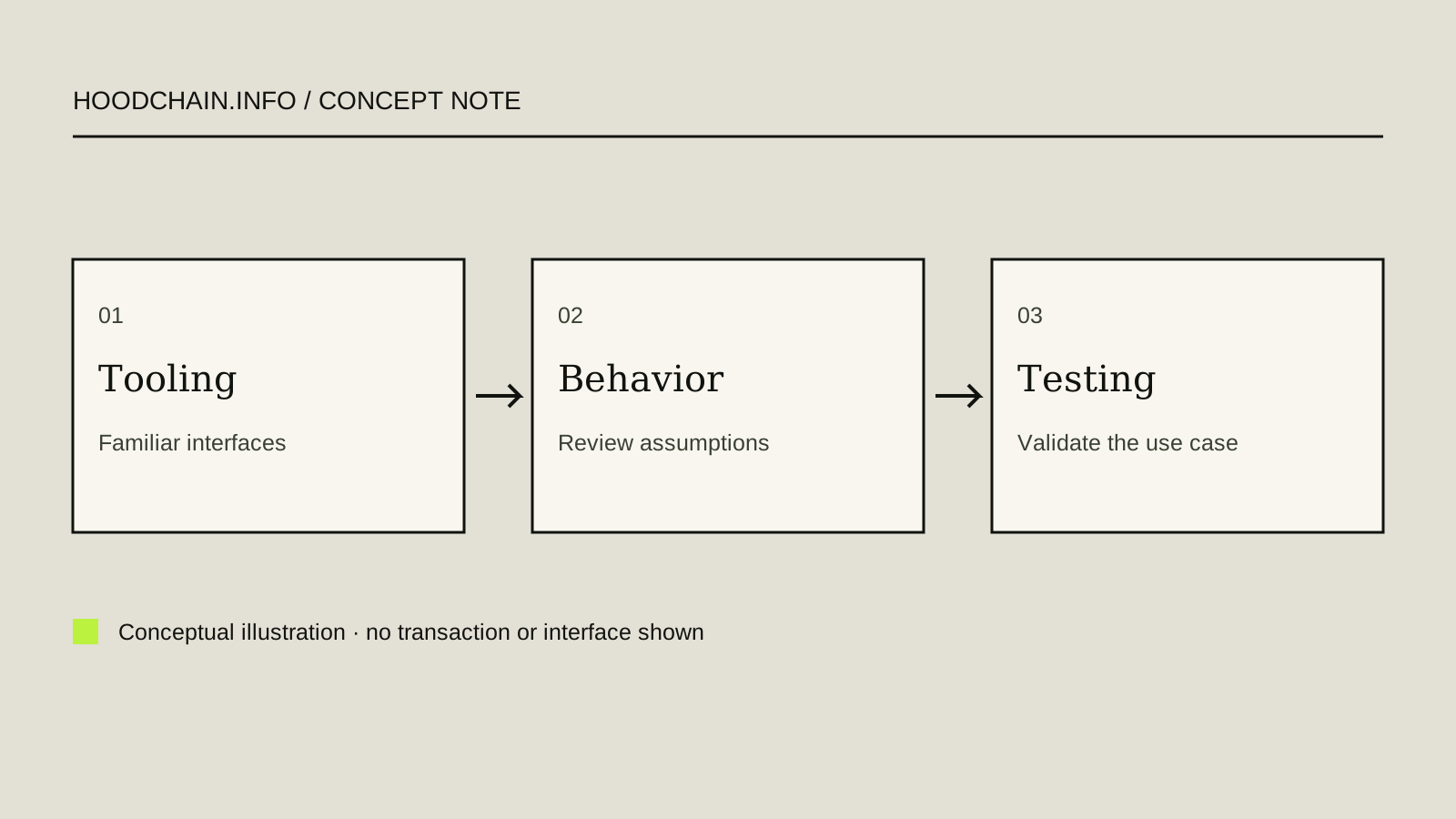
Compatible does not mean identical
Ethereum-compatible tools make familiar workflows possible, but the network still has its own processing and settlement behavior. A beginner should not transfer assumptions about blocks, fees or withdrawals without checking them.
The official developer documentation identifies several differences. Treat these as topics to validate in application-specific testing, not as proof that every existing Ethereum contract can be used safely.
Three differences a user will notice
- Gas: ETH still pays the ordinary native fee, but its balance must be on the selected network.
- Settlement: an early L2 receipt and later Ethereum settlement describe different stages.
- Return path: a canonical withdrawal has a process distinct from sending ETH between two Ethereum accounts.
A familiar address prefix does not collapse these differences. The exact chain ID and the destination’s supported network remain essential.
A focused checklist for developers
The reviewed differences page says Solidity’s block.number is an estimate of the L1 block number, and warns against using block.prevrandao as a randomness source. These are concrete examples of why EVM compatibility is not a complete specification of behavior.
Before adapting an application, review block assumptions, fee estimation, cross-chain sender identity, sequencer behavior, screening and chain-specific precompiles. Build tests around the assumptions your application actually uses. Documentation examples are not a substitute for reviewing access controls or contract dependencies.
Worked example: counting time with blocks
A hypothetical application unlocks a feature after a fixed difference in block.number. If the developer assumes that value is a precise counter of each L2 block, the behavior can differ from the intended timing model. The first question is what the value means on this chain, followed by a test of the application’s required timing semantics.
No contract was deployed or executed for this explanation. The point is to identify a dependency that must be verified before reusing a design.
Keep protocol and product questions separate
A chain can support an interface while a wallet, bridge or custodial service does not expose the action you want. Conversely, a polished app interface does not establish that a contract has been independently audited. Check the network, application and account boundary separately.