
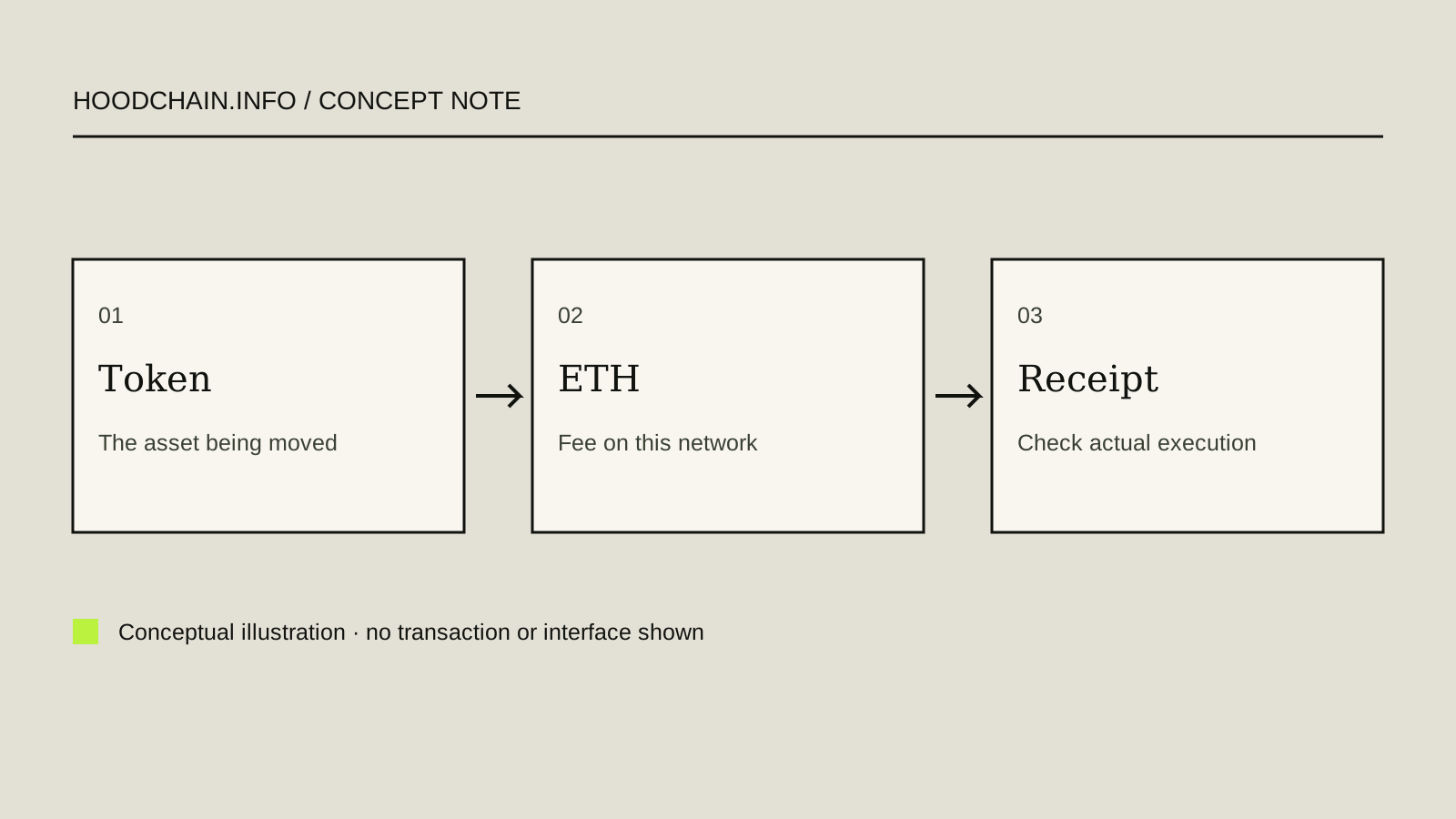
The asset you send and the asset that pays gas can differ
ETH is the native gas token on Robinhood Chain
A token balance is not necessarily a spendable gas balance. Robinhood Chain’s documentation specifies ETH as the native gas asset. An ordinary transaction therefore needs an adequate ETH balance on Robinhood Chain, even when the transaction concerns another token.
ETH displayed on Ethereum mainnet belongs to a different network record. It does not automatically pay the fee for an action on Robinhood Chain. Likewise, wrapped ETH is a token representation rather than the native gas balance.
Read the complete fee estimate
L2 execution fee plus L1 data fee
The official fee model combines an L2 execution fee (gas used × L2 gas price) and an L1 data fee for posting transaction data to Ethereum. The L1 component varies with Ethereum congestion and calldata size; the documentation says the two parts are bundled into the transaction fee rather than paid separately. For a reader, review the complete current wallet estimate instead of applying a fixed cost from an old article. The docs do not supply a universal price quote. An approval and a later swap may be separate transactions, with separate costs.
Applications, bridges and custodial services can quote additional charges. Separate network gas, route fees, trading fees and the amount of the destination asset. A low gas estimate does not prove the overall route is economical.
A hypothetical budget
Imagine a wallet shows a token balance but no native ETH. The user wants to transfer the token. Under an ordinary gas-paying flow, the transfer cannot be funded by the token balance alone. The missing requirement is ETH on that same network, not more of the token.
Some applications can sponsor fees or use a different fee arrangement. Verify that arrangement in the actual interface and its terms. “Gasless” does not prove that no one pays or that the action is free of all charges.
When planning a route, leave room for later actions, including a claim on another chain if required. This example gives no recommended deposit amount or live gas quote.
If a transaction fails
A failed execution can consume gas even though the intended token movement did not happen. Inspect the transaction receipt before repeating. A transaction rejected before broadcast is a different state and may have no onchain receipt at all.
Do not respond to a failure by blindly increasing amounts or signing repeated approvals. Identify whether the issue is insufficient native gas, a contract condition, a wrong network or something else. A screenshot of “insufficient funds” without the selected network and asset is incomplete evidence.
Related lessons: identify network and RPC scope, read fictional pending/reverted cases, and compare bridge paths.