
Name the action before choosing a route
Canonical bridge versus partner route
A same-network transfer changes the holder within one chain. A bridge moves value or a message across chains through a particular mechanism. A custodial withdrawal is a provider’s process for sending to a supported network. Those actions are not interchangeable.
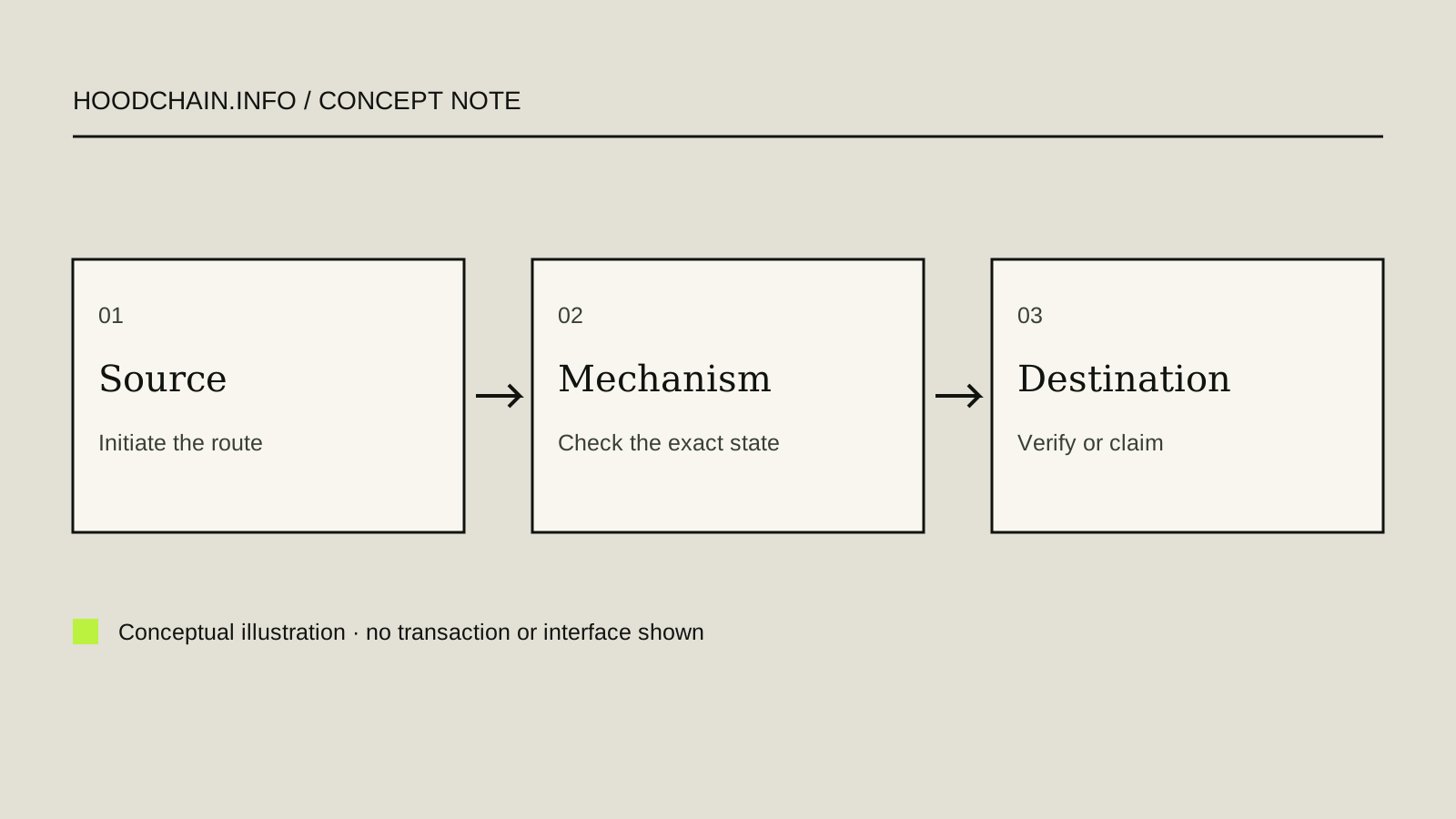
Start by identifying the source chain, destination chain, exact asset representation and recipient. Then ask how the selected route delivers the destination asset and what happens if one leg stalls.
The canonical return path has a separate waiting period
The reviewed Robinhood Chain bridging documentation describes a native Ethereum-to-Chain route and a return withdrawal with an approximately seven-day challenge period followed by a claim on Ethereum. The claim is a further action with L1 gas cost. It is different from ordinary transaction finality.
A plan that budgets only the first transaction can be incomplete. If you need access to the asset at a particular time, understand the route’s full sequence before starting.
A failed L2 deposit execution has a different clock
The official bridging documentation, reviewed 26 October 2026, describes a specific case: an Ethereum-to-Robinhood Chain canonical deposit whose L2 leg fails, for example because of insufficient gas. Its retryable ticket can be manually redeemed through the bridge interface within the documented seven-day window. This is an opportunity to complete the pending L2 execution, not a universal refund guarantee.
Keep the two clocks separate: the withdrawal challenge period is a wait on the Chain-to-Ethereum return route; the deposit-redemption window is a deadline for an eligible failed Ethereum-to-Chain L2 execution. Do not interpret the latter as an instruction to wait seven days before investigating. Check the ticket's actual state and deadline using the official process.
Read the official failed-deposit explanation under “Depositing” / “If a deposit does not arrive” and its bridge-interface link. The Arbitrum token-deposit troubleshooting procedure explains checking the retryable-ticket state and failed child-chain execution. Verify applicability to the exact route before taking any action.
A successful source receipt alone does not establish L2 completion. An unrelated bridge, unsupported asset, wrong destination or expired ticket can require different analysis. No redemption or recovery was attempted here, and no transfer is needed to study this case.
A faster quote changes the dependencies
Alternative routes can use liquidity, intents, messaging or token-transfer systems. Their completion and cost depend on their own supported pairs and current conditions. A faster advertised time is not a universal delivery guarantee.
Read the actual quote for the destination asset, minimum received, fees, recipient and expiration. A route that combines a swap and a bridge may change the asset as well as the network. Each additional component adds a question about failure and support.
A route comparison worksheet
| Question | Evidence to find |
|---|---|
| What arrives? | Destination chain, exact token deployment, amount and recipient |
| What does it cost? | Source gas, route fees, any approval, destination claim and exit cost |
| When is it usable? | Waiting periods and remaining actions, rather than the first receipt only |
| Who can help if it stalls? | Official status and route-specific support; transaction identifiers for both legs |
Fictional worked example: eligible canonical deposit ticket
Paper exercise only: every field is invented; no transfer, hash, amount, fee quote or redemption exists. Assume the official canonical Ethereum-to-Robinhood Chain flow is the route being described. The official documentation gives a narrow example: if that deposit’s L2 leg fails, such as for insufficient gas, a retryable ticket may be manually redeemed through the bridge interface within seven days. This is not a general recovery promise.
| Field | Fictional answer | What the field does not prove |
|---|---|---|
| Source network | Ethereum mainnet (L1) | That a source transaction was actually sent |
| Destination network | Robinhood Chain (L2) | That the L2 leg executed or the receiving balance was credited |
| Asset representation | ETH on Ethereum; intended destination is ETH on Robinhood Chain, whose docs identify ETH as native gas | That a real route selected or delivered this exact asset |
| Observed status | Fictional source receipt marked complete; fictional L2 leg reports failed for insufficient gas; bridge screen shows a retryable ticket | That any actual ticket exists, remains eligible or has not expired |
| Pending action | Read the exact source receipt and ticket state; only for the precise eligible canonical case, consult the official bridge interface procedure within its documented window | That manual redemption is universally available or guaranteed to recover funds |
| Costs to identify | Source-chain fee in the source receipt and any current L2/data or next-step fee shown by the official interface | Any amount, live quote, final fee or fee for this fictional case |
Answer key: what can and cannot be concluded
- The source is Ethereum L1 and the intended destination is Robinhood Chain L2; the same asset label does not merge their records.
- The case is specifically the documented canonical-deposit pattern with a failed L2 execution and a retryable ticket. An unrelated bridge, missing ticket, unsupported asset, wrong destination or expired ticket is outside this example.
- The documented manual-redemption window applies to that eligible failed deposit; it is not the Chain-to-Ethereum withdrawal delay and is not proof of universal recovery.
- Inspect actual receipt/ticket fee and status fields to identify costs; the example supplies no amount or quote.
- Still unknown from this fictional record: whether a real source transaction exists, whether a real ticket is eligible/current, the exact asset/recipient, fee amounts, current interface state and any receiving credit. No one redeemed or tested anything here.
Do not confuse this with a canonical withdrawal from Robinhood Chain to Ethereum: that separate route has a documented seven-day challenge wait followed by an L1 claim. Both clocks are distinct from the staged soft confirmation, Ethereum posting and Ethereum finality of an individual transaction.
If funds do not appear
Preserve the source hash and the route’s operation identifier. Determine whether the source action executed and whether a destination action or claim remains. Do not submit the same operation repeatedly because a wallet balance has not refreshed.
Use the route’s official instructions for its specific failure state. Do not interpret this guide as a universal refund procedure. No route, latency or recovery process was tested here.
Related read-only checks: confirm the network and chain ID, then inspect the relevant receipt with the explorer guide and account for the network gas components.