
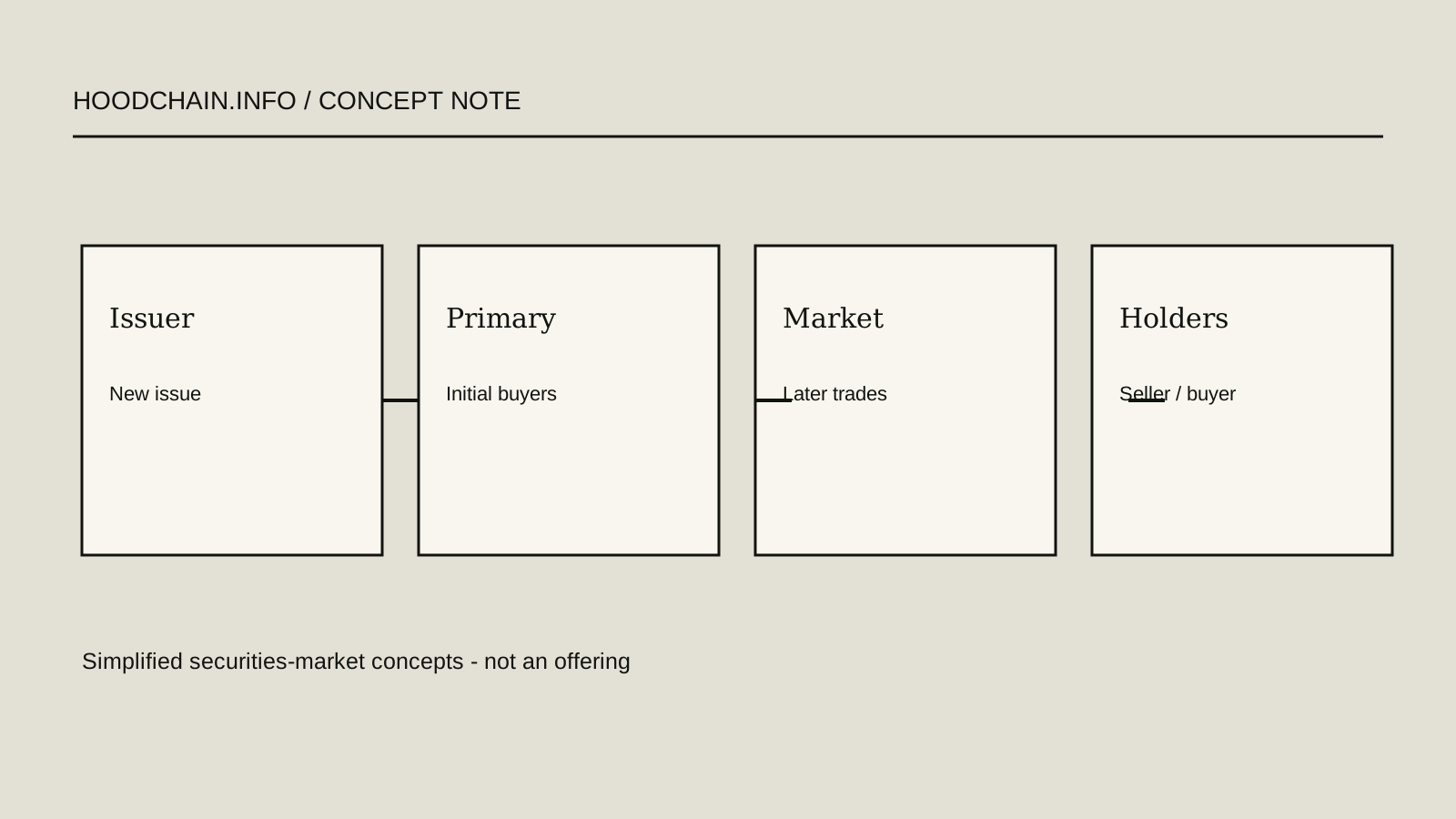
Issuing a security and trading it later are different events
A primary-market offering sells newly issued securities to investors; the issuer receives the proceeds. A secondary-market trade is a later purchase and sale of an existing security. The buyer pays the seller through market intermediaries; that trade does not itself route its gross purchase price to the original issuer.
This is a simplified securities-market lesson based on SEC Investor.gov definitions. Offering structures, underwriting, fees, settlement, private offerings and later issuer transactions can differ. Reviewed 26 October 2026; no security or order is involved.
Follow the instrument from issuer to later holders
- Issuer: a company or government creates and offers an instrument under applicable documents and law.
- Primary distribution: initial buyers purchase newly issued securities; gross proceeds go to the issuer, subject to costs and offering terms.
- Secondary trading: holders later trade existing securities with other buyers. The issuer is generally not the counterparty to each resale.
- Price discovery: bids, offers, trades and information can affect quoted market value; price is not the same as cash raised by the issuer.
“Primary” and “secondary” identify transaction context, not whether a security is safe, liquid or fairly priced. An issuer can make another offering or other corporate transaction later; that is distinct from an ordinary holder-to-holder resale.
Participants, proceeds and price discovery
| Question | Primary issuance | Secondary trade |
|---|---|---|
| What changes hands? | Newly issued security and subscription payment | Existing security and trade payment |
| Who receives gross proceeds? | Issuer, before offering costs and contractual distributions | Seller, before fees and taxes; intermediaries may also be paid |
| What can the price tell you? | Offer terms for a particular issuance | Observed bids/offers/trades for existing securities, under market rules |
| What does it not prove? | That the security is suitable or trades later at the offer price | That the issuer receives each resale's proceeds or that all shares trade at one price |
Fictional exercise P-76: who receives the money?
Invented arithmetic: an issuer sells 100 newly created units at $10 each in a simplified primary offer. Gross subscription proceeds are 100 × $10 = $1,000, before costs or other terms. Later, one holder sells 10 existing units to another investor at $12 each in a fictional secondary trade. Gross trade value is 10 × $12 = $120.
Answer: the issuer receives the primary offering proceeds in this simplified case. In the later secondary trade, the seller receives the trade price before fees; the issuer does not receive that $120 merely because its security changed hands. The later price may contribute to price discovery, but it does not retroactively change primary proceeds.
Check the offering and market records
For a real instrument, identify whether the document describes a new issue, an existing-security trade, a fund creation/redemption mechanism, or a different contractual product. Read applicable offering documents, issuer disclosures, venue rules and trade confirmations. This example does not cover every debt, fund, tokenized or private-market structure and is not legal or investment advice.