
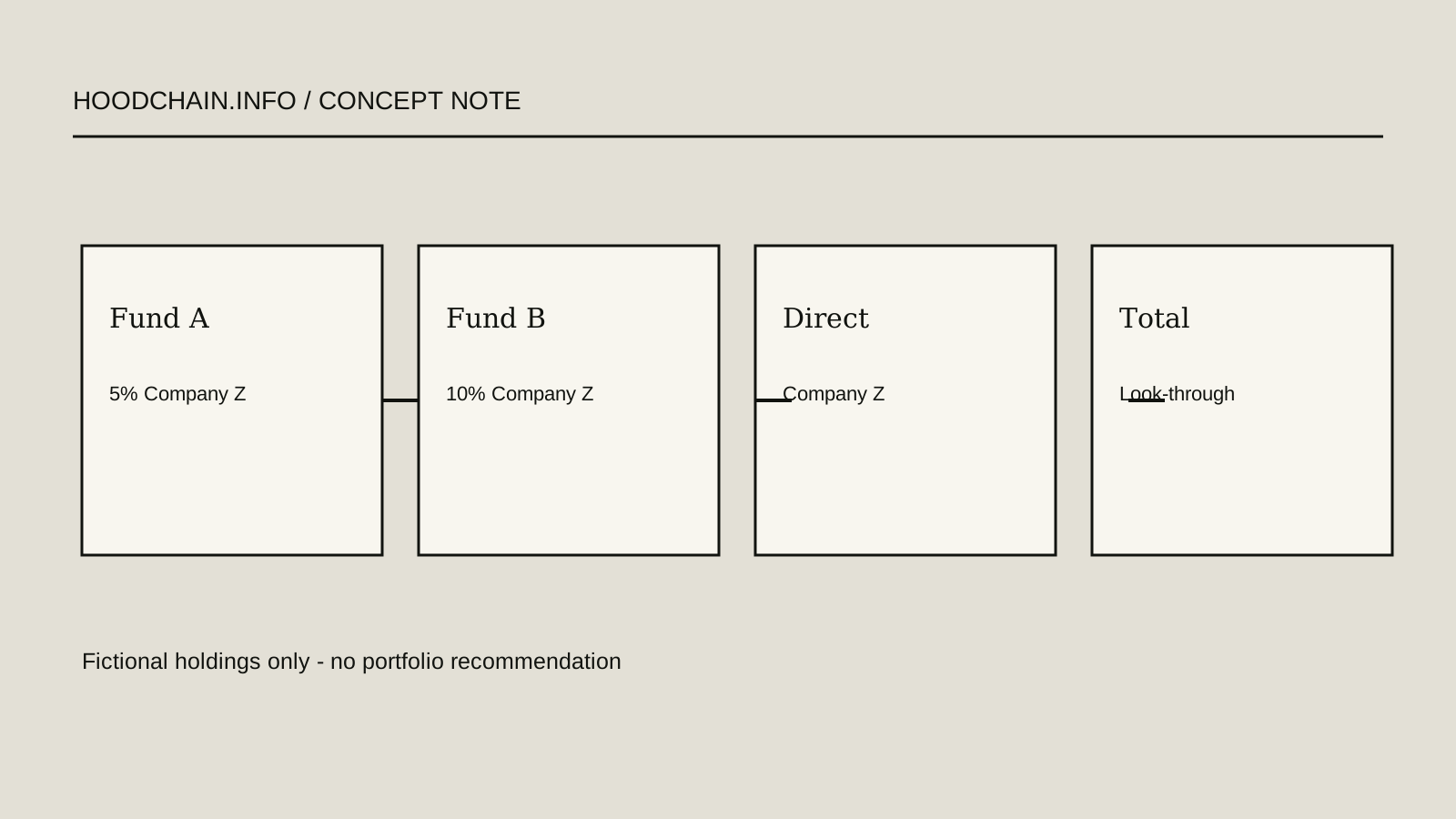
More line items do not always mean more independent exposure
Diversification spreads exposure across investments or risk sources. Several funds and direct securities can still share issuers, sectors or economic drivers. Concentration can hide under different product names.
The calculation below is entirely fictional and is not a portfolio recommendation. Investor.gov describes diversification as one way to reduce risk while directing readers to inspect underlying holdings; diversification does not guarantee against losses. Sources reviewed 26 October 2026.
Look through holdings to see shared exposure
For a simplified issuer exposure, multiply each position's value by its share of the target issuer, then sum across positions. Do not count the same underlying exposure as independent merely because it appears through a different fund and a direct holding.
Solved fictional overlap calculation
| Position | Fictional value | Company Z weight inside position | Look-through exposure |
|---|---|---|---|
| Broad Fund A | $2,000 | 5% | $100 |
| Sector Fund B | $1,000 | 10% | $100 |
| Direct Company Z shares | $1,000 | 100% | $1,000 |
| Total | $4,000 | — | $1,200 |
Answer: Company Z exposure is $100 + $100 + $1,000 = $1,200. Divide by the fictional $4,000 total: $1,200 ÷ $4,000 = 30%. There are three position lines, but they do not represent three independent Company Z exposures. The labels, values and weights are invented.
Overlap and correlation are different questions
Holdings overlap asks whether positions own the same issuer or instrument. Correlation estimates how returns moved together over a stated historical window. Two holdings can share an issuer directly or move together because they share sector, currency, rates or wider market exposure. Correlation depends on the observations and window; it can change and does not guarantee future co-movement.
Spreading exposure can reduce concentration in some risks, but broad market declines and shared factors can affect many positions at once. Diversification cannot remove all market risk or guarantee a positive result.
A neutral checklist for reviewing exposure
- Write the value and look-through weight of material underlying issuers, not just account lines.
- Check sector, geography, currency and common economic drivers using dated source documents.
- Separate fund look-through exposure from direct holdings and avoid double-counting it as independent risk.
- If using correlation, state the assets, date window, return frequency and data limitations.
- Do not treat a diversified label, past co-movement or a larger holdings count as protection from loss.
This is a learning tool, not personalized portfolio construction, rebalancing, tax or investment advice.