
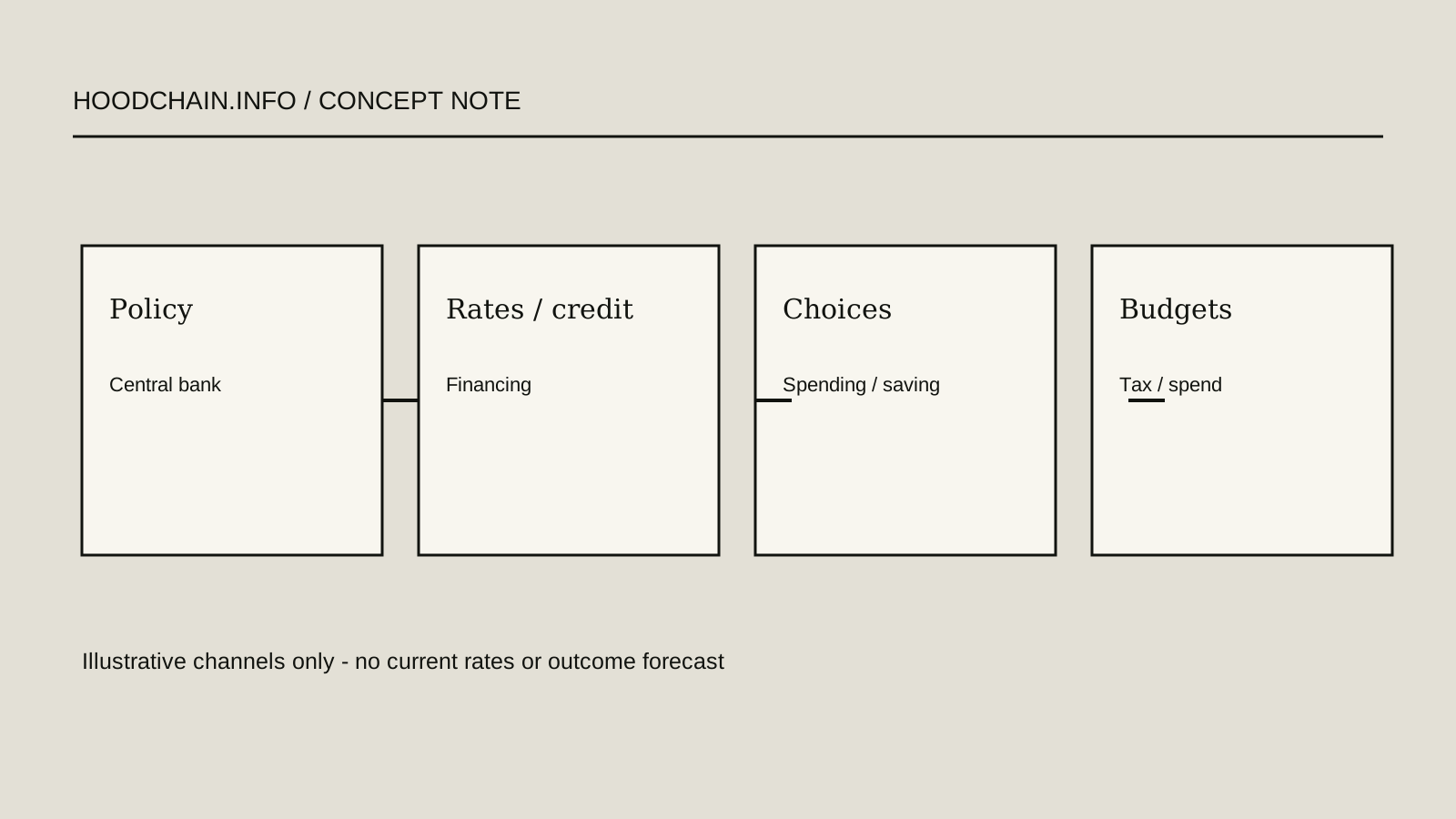
Short answer: policy influences conditions, not a guaranteed result
A central bank can influence short-term rates and wider financing conditions through monetary-policy tools. Those changes may affect lending and saving costs, asset prices, exchange rates and spending over time. The path is indirect and uncertain; it does not mechanically set every household rate or determine any asset's price.
This page separates U72, rate transmission and limits, from U73, government tax-and-spending policy. Sources reviewed 26 October 2026; no current policy rates or forecasts are used.
How policy-rate changes can travel through an economy
- A policy committee sets or changes a tool and communicates its stance.
- Money-market and other rates may respond. Banks' funding costs, competition, borrower risk and contract terms affect pass-through to customer lending or deposit rates.
- Households and firms may alter borrowing, saving, purchases and investment. Asset prices and exchange rates can also respond to changed expectations and financing conditions.
- Spending and credit conditions can affect demand, employment and prices. Timing and size vary by country and situation.
The Federal Reserve describes the federal-funds target range as a way to influence short-term rates and broader financial conditions. The ECB describes rates affecting money-market rates directly and customer lending/deposit rates indirectly; its transmission mechanism has long, variable and uncertain lags. The Bank of England says Bank Rate influences other rates and its full effects can take time. These are mechanisms, not promises that every bank reprices alike.
Three institutions, distinct settings
| Institution / scope | Documented channel | Not established |
|---|---|---|
| Federal Reserve / U.S. | FOMC target range for overnight federal-funds borrowing; implementation tools help align short-term rates | A fixed change in a mortgage, deposit, card or crypto price |
| ECB / euro area | Official rates affect money-market rates directly and customer lending/deposit rates indirectly; expectations and asset prices are other channels | One uniform retail rate or identical pass-through in every country |
| Bank of England / UK | Bank Rate influences other interest rates; the Bank describes bond purchases as a tool for longer-term rates when used | An immediate inflation change or exact household pass-through |
Sources: Federal Reserve monetary policy, ECB transmission, and Bank of England monetary policy, reviewed 26 October 2026.
Fictional exercise M-72: follow the channel, then name the unknowns
Fictional, not a current rate or forecast: a central bank raises a short-term policy rate. A bank's funding costs may rise; a household has a variable-rate loan that resets next month.
Answer: a higher payment is plausible after reset, but the exact amount depends on the contract benchmark, margin, caps, reset date and lender. A fixed-rate loan may not reset. The scenario cannot predict stock, bond or crypto prices; expectations, cash flows, supply, demand and risk also matter.
Monetary and fiscal policy have different actors and tools
| Policy | Main actor in U.S. example | Illustrative tools | Basic channel |
|---|---|---|---|
| Monetary | Federal Reserve; FOMC sets the stance | Federal-funds target range and implementation tools such as interest on reserve balances | Influence rates and financial conditions, affecting credit and demand |
| Fiscal | Congress and the Administration for U.S. federal policy | Taxes, public spending, transfers and budget decisions | Change public revenue/outlays and private cash flows; can affect aggregate demand |
The Federal Reserve's U.S.-scoped FAQ defines fiscal policy as national-government tax and spending policy and says Congress and the Administration determine U.S. fiscal decisions; the Fed does not. A budget deficit and a central bank's monetary operations are different descriptions. A deficit is not, by definition, proof that a central bank created money or that a market price must rise.
Fictional exercise M-73: two decisions at once
Invented scenario: a legislature approves a temporary spending increase while its central bank independently raises its policy rate. Do the actions contradict each other?
Answer: they are separate decisions by distinct institutions using different tools. They may influence demand in different directions and interact, but the net effect depends on scale, timing, financing, expectations and economic conditions. Do not reduce the case to “deficit means money printing,” and do not infer inevitable inflation or an investment trade.
What the policy map cannot predict
Policy explanations describe possible channels. They do not identify the sole cause of an observed change, reveal a future committee decision, or forecast returns. Verify institution, jurisdiction, measure and decision date. This is education, not investment or macroeconomic advice.