
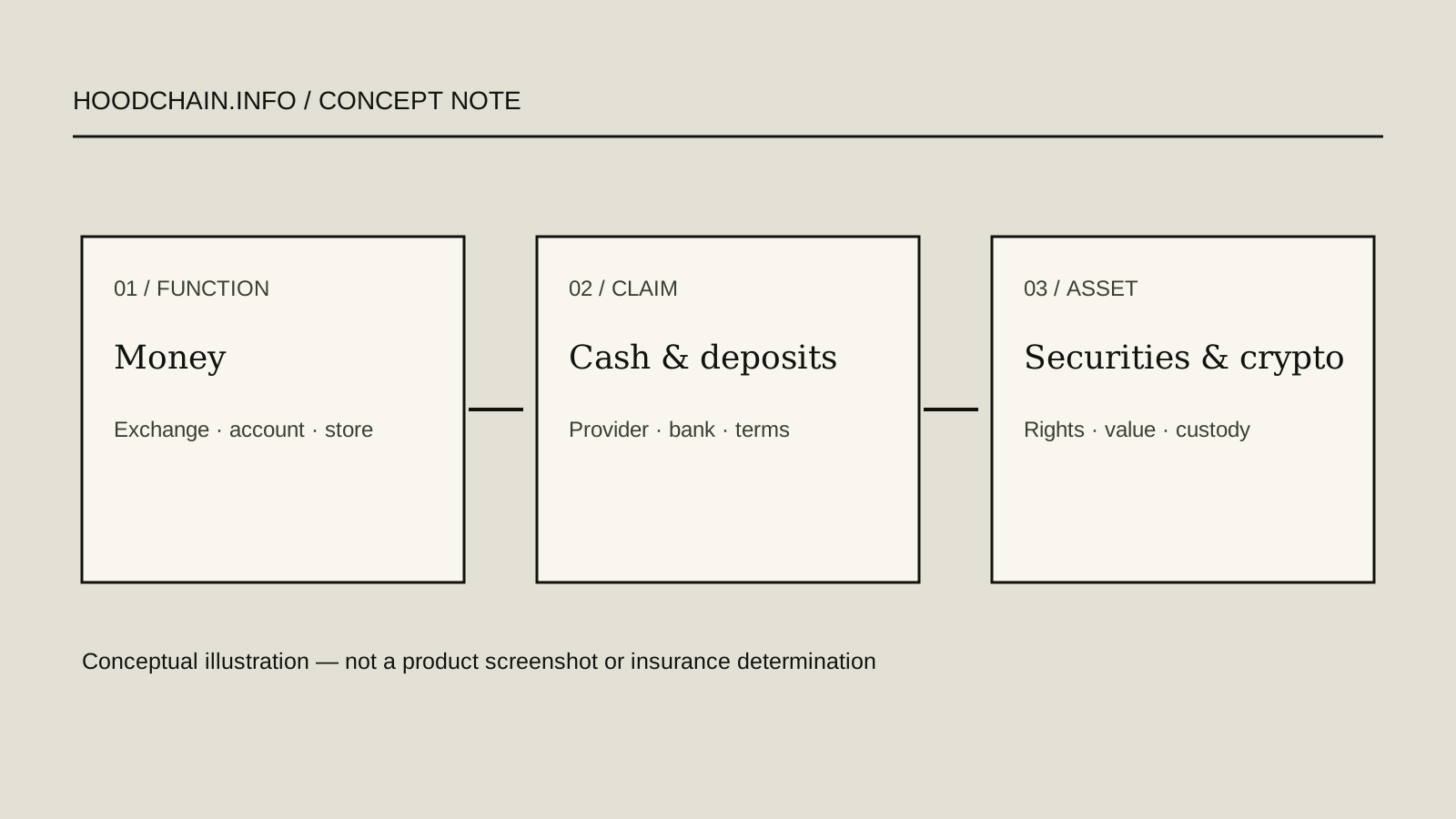
Money, cash, deposits and assets are related, but not interchangeable
Money is commonly described by three functions: a medium of exchange, a unit of account and a store of value. A cash balance, a bank deposit, a stock, a bond and a crypto token are different things even when an app displays them beside one another. A label or dollar value does not by itself tell you who owes you what, who controls the asset, how quickly it can be converted, or whether a protection applies.
This is general financial-literacy education, not a recommendation to buy, hold or sell anything. Examples below are fictional; no account or financial product was tested.
Separate money functions from asset categories
Three functions of money
- Medium of exchange: something accepted to pay for goods or services.
- Unit of account: a common unit for quoting and comparing prices.
- Store of value: a way to carry purchasing power across time, although its value can change.
An instrument can serve one function imperfectly or only in a particular context. A crypto token may be quoted in dollars and may be used for some payments, but that does not make it equivalent to cash or a bank deposit. A token’s market price can move sharply.
Cash, deposits and investment assets
Physical cash is currency. A bank deposit is a claim recorded by a bank under the account terms. A stock represents an ownership interest in a company; a bond is a debt obligation with terms; and an ETF is a fund whose holdings and risks depend on its prospectus. A crypto asset is a digital asset recorded or represented using a network; its rights and transfer rules depend on the asset, issuer (if any), contract and applicable terms.
Investor.gov groups stocks, bonds and cash as major asset classes for introductory education. These categories are broad and do not mean that assets in one group have the same risk, liquidity or legal protections.
A displayed cash label does not establish deposit insurance
In the United States, FDIC insurance applies to eligible deposits at FDIC-insured banks subject to coverage rules and limits. FDIC materials specifically distinguish bank deposits from non-deposit investments such as stocks, bonds, mutual funds and crypto assets, which are not FDIC-insured. The fact that an app, brokerage or fintech displays a cash-like balance does not prove which bank holds it, whether the product is an eligible deposit, who owns the deposit for coverage purposes, or what limits apply. Check the named provider, bank, account agreement and current FDIC guidance.
This statement is limited to the U.S. FDIC system. It does not describe UK or European protection schemes, brokerage protection, crypto custody, market-loss protection or any particular provider’s account. Insurance is not a guarantee against investment losses, price declines, fraud or service interruption.
Fictional exercise F-01: classify the label before drawing a conclusion
Suppose a fictional statement shows five lines: (1) a $20 banknote; (2) “$500 cash balance” at a fictional financial app, with no bank or agreement named; (3) 10 shares of “Example Co.”; (4) a bond issued by “Sample Transit”; and (5) 0.02 units of a fictional crypto token. What can you conclude from these labels alone?
Show the answer key
- The banknote is physical currency and can function as a medium of exchange where accepted.
- The app’s cash label is insufficient to identify a bank deposit, custodial arrangement, withdrawal right or insurance coverage. Find the legal provider and account terms before classifying it further.
- The shares are an ownership interest in a company, not a bank deposit; their market value can change.
- The bond is a debt claim with issuer and contract terms, not cash; repayment and market risks remain.
- The token is a crypto asset. A displayed dollar quote does not establish redemption rights, stable value, deposit insurance or a guaranteed buyer.
The exercise is conceptual and fictional. It does not describe a real account, issuer or product.
A read-only checklist for comparing balances
- Identify the product, legal entity, region and agreement behind the display.
- Ask whether the item is physical currency, a bank deposit, a security, a fund share, a debt claim or a crypto asset.
- For a deposit-insurance claim, verify the actual insured bank, eligible deposit product, ownership category and current coverage limits directly with official U.S. FDIC materials.
- Separate value risk, access/withdrawal rules, custody and legal protection. They answer different questions.
- If the label or provider is unclear, do not infer a protection from a ticker, app screen or dollar-denominated quote.
Use the inflation and real-return guide to understand how a price index changes purchasing-power calculations. This checklist does not determine suitability or guarantee recovery.