
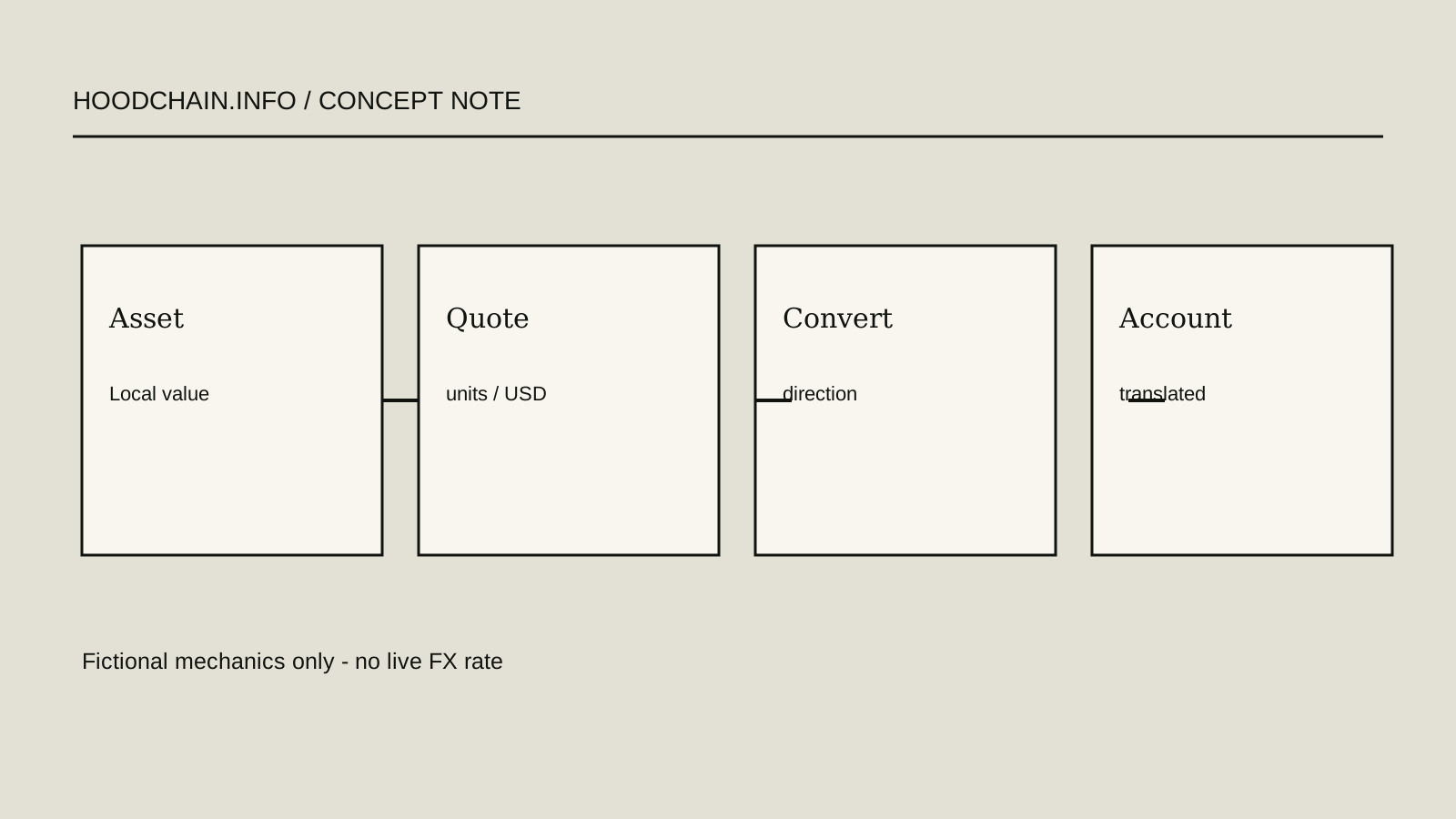
A translated value can move even if the asset price does not
If an asset is valued in one currency and your account or future spending is in another, exchange-rate movement can raise or lower the translated value. That movement is separate from a change in the asset's own local-currency price.
This guide uses fictional fixed rates only. It does not report a current exchange rate, recommend a currency trade, or describe a particular broker's account feature. Investor.gov's risk discussion is U.S.-investor scoped. Reviewed 26 October 2026.
Keep account, asset and spending currencies separate
| Fictional context | Account/reporting currency | Asset denomination | Possible spending currency |
|---|---|---|---|
| U.S.-resident example | USD | EUR-valued asset | USD |
| UK-resident example | GBP | USD-valued asset | GBP |
Country labels here describe currency roles, not eligibility or product availability. A statement may translate a value using a provider's chosen rate and time, and may include a spread or fee. The account display and a later cash conversion may use different rates; read the current terms and transaction record.
Solved fictional currency conversion
Invented exercise: a U.S.-based learner holds an asset whose value stays at 100 F-units. At the fictional quote 1 USD = 1.25 F, the USD translation is 100 ÷ 1.25 = $80.00. In another fictional scenario, the quote becomes 1 USD = 1.50 F while the asset remains 100 F-units. The translated value is 100 ÷ 1.50 = $66.67. FX translation alone is $13.33 lower, about 16.67% from $80. The asset's F-unit price did not change.
Direction check: the quote is F-units per USD, so divide F-units by the rate to get USD. A quote stated as USD per F-unit would require multiplication. Both quotes and inputs are invented; no actual conversion was performed.
Check quote orientation, costs and timing
- Record account, asset/trade and eventual spending currencies.
- Copy the quote direction with units, e.g., “foreign units per USD.”
- Use the matching divide or multiply operation, then compare with the asset-currency value.
- Check separately for the disclosed rate, spread/fee, conversion time, settlement and any currency restrictions.
- Keep asset price movement, FX translation and actual conversion cost as distinct line items.
SEC Investor.gov notes that exchange-rate changes can increase or reduce the U.S.-dollar return on an international investment and that currency controls may matter. This general discussion does not establish any specific provider's rate or execution cost.
What the example leaves out
The arithmetic assumes a static asset price, one rate and no fee, spread, tax, timing difference, settlement delay or control. It is not a forecast, valuation, personalized tax calculation or investment recommendation.