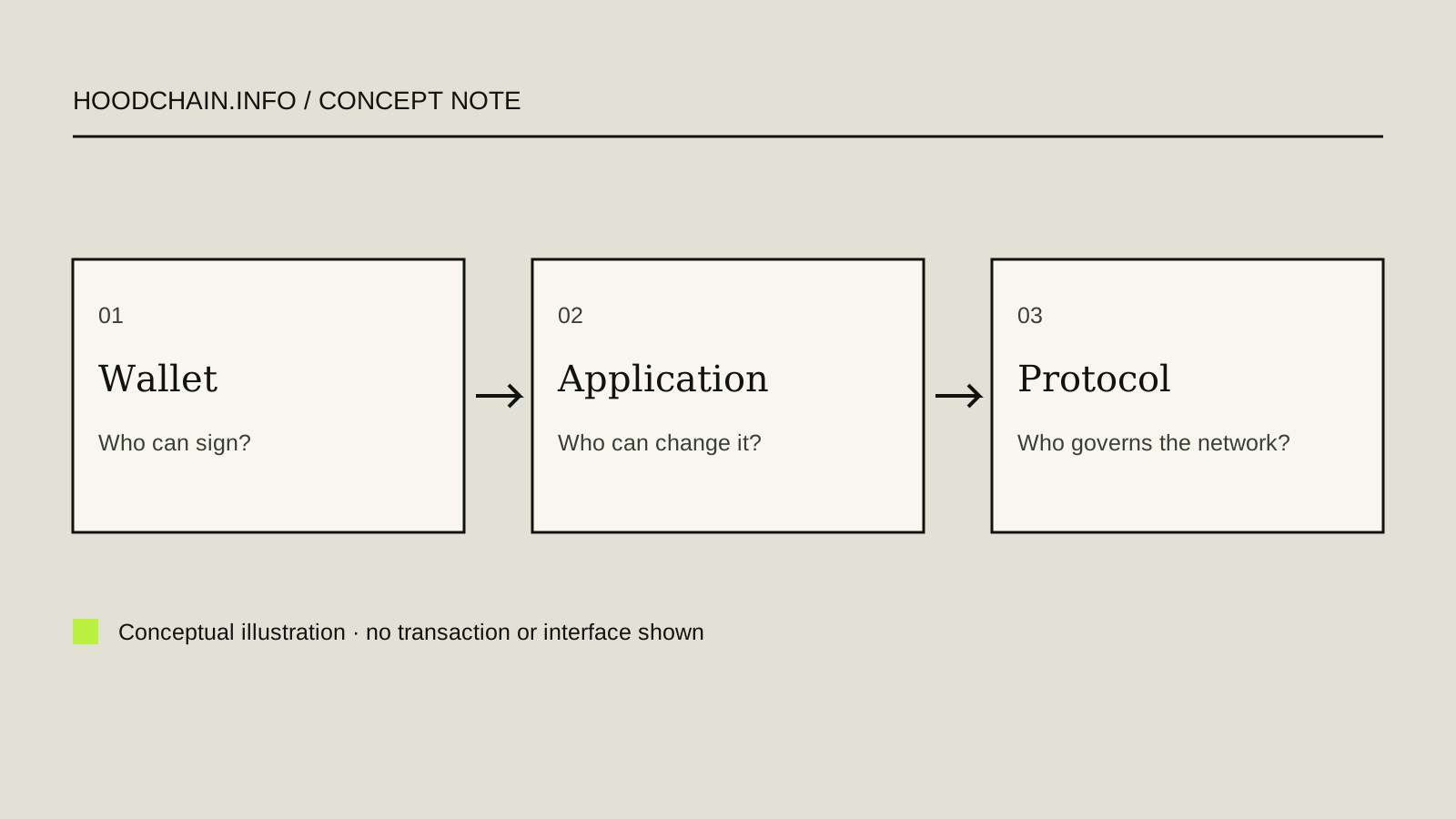
Understand who can change the protocol
A blockchain’s risk model includes its upgrade and emergency controls. A beginner can ask a useful question without auditing code: “Who can change the system, under which approval threshold, and how much notice is required?”
The governance documentation reviewed on 25 October 2026 describes eight Security Council signers, routine actions requiring six signatures with a seven-day timelock, and emergency actions requiring seven signatures without that delay. Those are documented controls, not independently verified onchain findings.
Transaction access and validation are separate
The same documentation describes BoLD dispute resolution with a permissioned validator set, currently naming Offchain Labs and Alchemy as validators. A network being available for users does not imply every protocol role has unrestricted participation.
Separate the ability to submit a transaction, the ordering of transactions, validation of state assertions and authority to upgrade contracts. They answer different questions about control.
Security claims have a scope
Robinhood Chain’s Terms of Service (updated 24 August 2026) identify RHDA, LLC as provider of the defined Chain services and state that the Chain protocol, associated bridging contracts and third-party infrastructure are outside those services. The terms say Robinhood does not take custody or control of digital assets on Chain and provide no uptime or continuous-availability guarantee for the sequencer; the public RPC is rate-limited and has no uptime/data-completeness guarantee. A directory entry, published governance design, or successful interface response is not an independent audit or a warranty that a contract or application is safe.
Separate risks by layer: sequencer availability and ordering, protocol upgrades and emergency controls, bridge/oracle dependencies, third-party application contracts, and self-custody key control. These published statements help frame questions; this article did not inspect deployed keys, execute a transaction, verify live service health, or audit code. If documentation and observed onchain configuration conflict, do not assume which is current without dated primary evidence.
Fictional evidence exercise
Case S-F11 is invented: a project directory lists an application, while no audit, contract address, upgrade authority or incident record is supplied. What can be concluded? Only that the example assumes a listing; safety, deployment identity and live operation remain unverified. Seek the exact contract and primary project documentation, then review upgrade, pause and oracle controls without connecting a wallet or signing anything.
What this changes for a user
Protocol governance risk is additional to the risk of your chosen application. A wallet you control cannot remove every dependency of the contracts or network it uses. A well-known validator or signer does not guarantee that all applications are safe.
Before placing substantial reliance on an application, investigate whether its own contracts are upgradeable, pausable or dependent on an oracle or issuer. Evaluate those controls separately from the chain’s governance.
What to look for in an update
- Which contract or protocol behavior changes?
- Which governance path authorizes it?
- When can it execute, and is there an emergency exception?
- What user actions, if any, are actually required?
- Where is the primary notice and its date?
An unsolicited instruction to move funds immediately is not a substitute for a primary notice. Do not sign a “migration” solely because a message invokes an upgrade.
Limits of this lesson
This review did not inspect deployed signer keys, timelock storage, validator operation or a running dispute. It explains the published control model so a reader knows what further evidence to seek. If current onchain configuration and documentation differ, resolve that discrepancy before treating the document as the final authority for an action.