
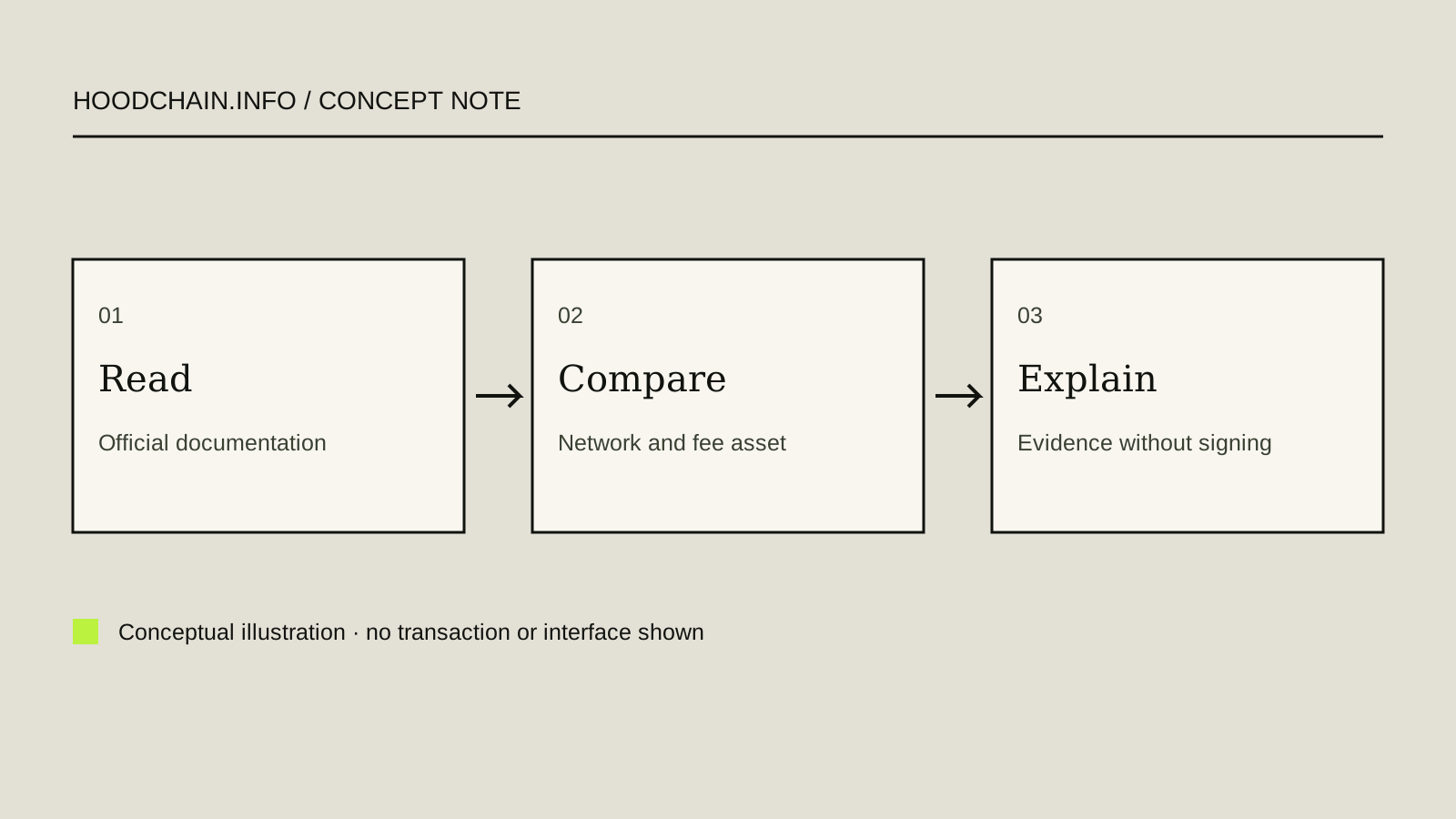
You can learn the network without operating it
Reading documentation, comparing a network configuration and inspecting a public transaction are different from signing an action. You do not need to buy an asset, reveal keys or connect a wallet to begin learning.
A useful first exercise is to trace the evidence you would need for a future action. Identify the product, intended network, likely fee asset and public place where the result could be inspected. Leave the actual action for a separate informed decision.
Understand the roles: network, asset and record
- Network: the distinct ledger and rules that record activity. Bitcoin, Ethereum mainnet and Robinhood Chain are different networks; Robinhood Chain documentation describes it as an Ethereum-compatible Arbitrum Layer 2 built on Ethereum.
- Native asset: the protocol-level asset of a network. BTC is Bitcoin’s native asset. ETH is Ethereum’s native cryptocurrency. Robinhood Chain documentation separately identifies ETH as that chain’s native gas token. A ticker can be reused across networks; that does not make balances, transfer routes or asset records interchangeable.
- Contract token: an asset whose balances and rules are tracked by a smart contract on a particular network. ERC-20 is a token standard for fungible tokens on Ethereum; the standard does not make a token’s name or symbol unique or prove its issuer, value or safety.
- Wrapped or bridged representation: a token on one network that represents or is intended to correspond to an asset from another context. WETH, for example, is an ERC-20 representation of Ether on Ethereum, while ETH itself is the network’s native asset. Bridge designs and backing/withdrawal assumptions vary; a representation is not automatically the original native coin, and bridge or contract risk may apply.
- Account, wallet and explorer: an account is a position recorded by a service; a self-custody wallet interface may display assets for one or more networks; an explorer is a public read surface. None of those labels by itself establishes who controls keys, what a provider supports, or whether a displayed token is the intended contract.
Gas is a network fee concept, not a universal synonym for an asset balance. ETH on Ethereum and ETH shown for Robinhood Chain refer to each network’s context. A fee asset documented for one chain does not prove a provider account can withdraw that asset, or that the same ticker on another chain can pay the fee.
Native coin, contract token and representation: a documentation-only comparison
| Label | What it names | What it does not prove |
|---|---|---|
| Bitcoin / BTC | Bitcoin is a network; BTC is its native asset in the basic Bitcoin documentation. | It does not say a Robinhood product supports a particular BTC deposit or withdrawal. |
| Ethereum / ETH | Ethereum is a network; ETH is its native cryptocurrency and gas asset. | It does not mean every token using a similar ticker is native ETH. |
| Ethereum / ERC-20 token | A contract can implement the ERC-20 fungible-token interface and maintain token balances on Ethereum. | The standard, name or ticker alone does not identify a trustworthy issuer or unique contract. |
| Ethereum / WETH | WETH is a contract-issued ERC-20 representation of Ether, distinct from protocol-native ETH. | It is not the same contract-level asset as native ETH, and other WETH variants may differ. |
| Robinhood Chain / ETH | Robinhood Chain’s current documentation calls it an Arbitrum Ethereum Layer 2 and names ETH as its native gas token. | This does not establish that any particular Robinhood account, custodian, token or transfer route supports it. |
| Fictional Luma L2 / “BTC-L” | In this made-up example, BTC-L is a bridged representation token intended to track BTC on the fictional Luma network. | It is not native BTC; the name does not establish backing, redemption, bridge safety or real-world availability. |
Use the network plus asset type and, for a contract token, the chain-specific contract identity from a primary source. A public symbol is not a unique identifier. Reading these concepts requires no wallet, funds, RPC call or transaction.
Sources: Bitcoin’s how-it-works guide, ethereum.org’s Ether guide, ERC-20 documentation, WETH explanation, Ethereum.org’s bridge overview, and Robinhood Chain’s network configuration documentation (all accessed 26 October 2026).
A documentation-only check
- Open the official Chain documentation. Confirm the domain and review date.
- Find the mainnet chain ID and native gas asset.
- Follow the documented explorer link and observe that it is a public reading surface.
- Describe what you would need to interpret a transaction: network, hash, action and intended result.
This candidate did the documentation review. It did not use an RPC, submit a transaction or check an individual account. You can stop at reading; there is no requirement to interact with a contract.
Fictional classification exercise: identify the network and asset type
Every label below is an educational example; BTC-L and Luma are invented. No wallet, funds, RPC, account or transaction was used. Classify each line as a network, native asset, contract token, or wrapped/bridged representation. A line may name more than one role.
- Bitcoin network; BTC balance.
- Ethereum mainnet; ETH balance.
- Ethereum mainnet; “CEDAR” described as an ERC-20 token (CEDAR is fictional; no address is provided).
- Ethereum mainnet; WETH.
- Robinhood Chain; documentation lists ETH as its native gas token.
- Fictional Luma L2; BTC-L is described as a token representing BTC through a fictional bridge.
Show the answer key
- Bitcoin is the network; BTC is the native asset in the cited basic Bitcoin model.
- Ethereum is the network; ETH is Ethereum’s native asset.
- Ethereum is the network; CEDAR is a contract token using the ERC-20 standard. The fictional ticker does not identify a real contract or establish who issued it.
- Ethereum is the network; WETH is an ERC-20 contract representation of Ether, not protocol-native ETH.
- Robinhood Chain is a separate L2 network; its official docs identify ETH as its native gas token. This documentation statement does not establish availability in an account or provider transfer support.
- Luma is the fictional network; BTC-L is a fictional bridged representation token, not Bitcoin’s native BTC. No bridge, backing or redemption claim is being made.
If a real-world label cannot be matched to an exact network and authoritative token identity, classify it as unverified and stop there. Do not infer from ticker, logo or address shape.
How you know the exercise worked
You should be able to name the correct network, distinguish a documentation claim from a live test and explain why an explorer is useful without connecting a wallet. If an interface asks for a signature during a reading task, identify that as a new action requiring its own explanation.