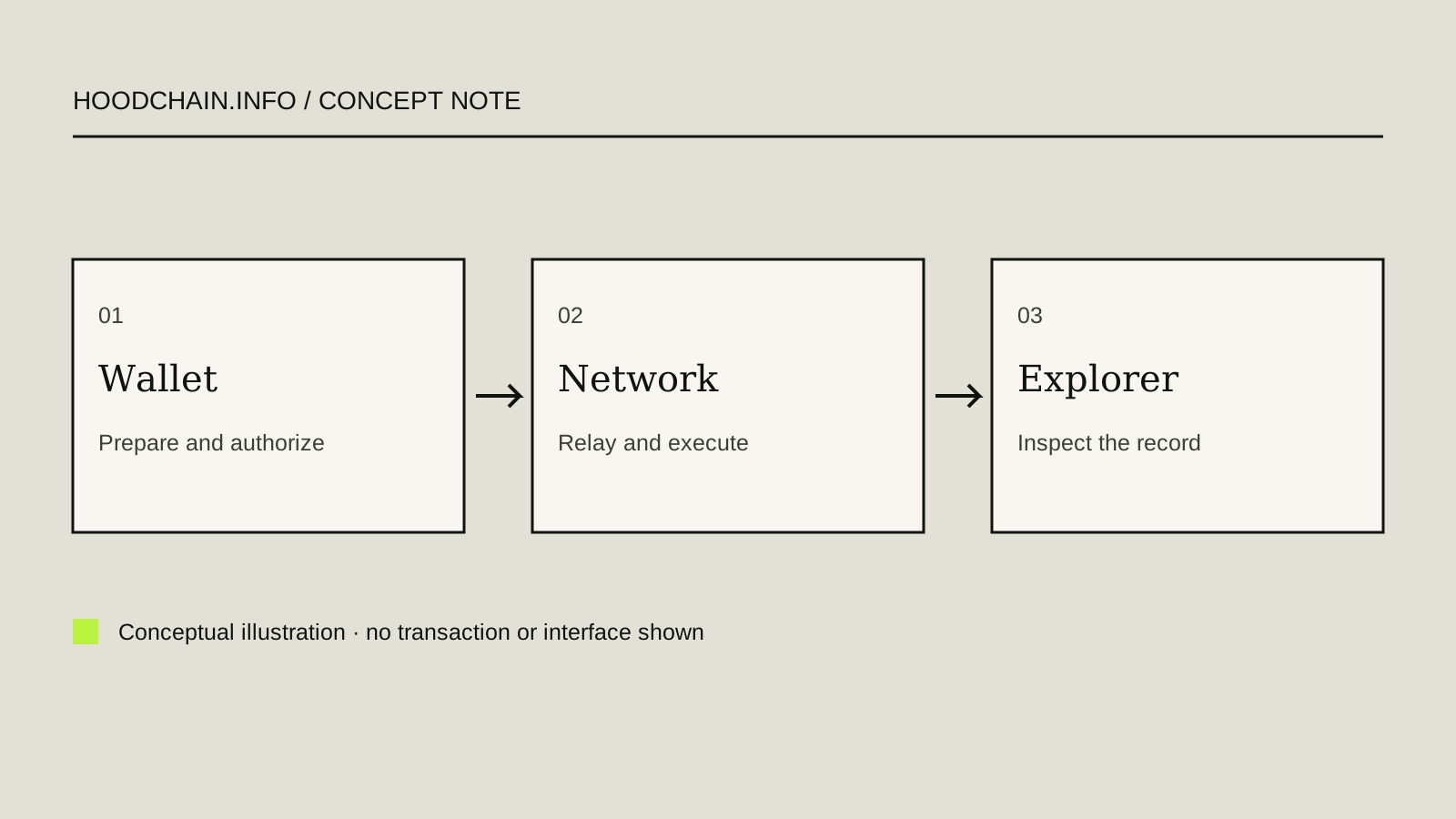
Trace one request through the stack
A wallet prepares an action. An RPC provider carries the request to the network. Network components order and execute it. An explorer indexes the resulting public record. The application decides which contract interaction the user is being asked to authorize.
For a cross-chain action, a bridge adds a mechanism for delivering value or a message to another network. An oracle supplies external information to a contract; it does not act as a general assurance that the application is safe.
Match a symptom with the right layer
| Symptom | Useful evidence |
|---|---|
| Wallet balance will not load | Selected account and chain, provider error, corresponding explorer record |
| Transaction hash cannot be found | Whether the source broadcast it and whether the explorer matches the network |
| Bridge source leg executed | Destination operation status and any remaining claim |
| App shows a price | Oracle/data source, units, timestamp and whether a real quote is executable |
Diagnose a timeout without declaring the chain down
One failed interface or RPC response cannot establish a network-wide outage. First record the product, selected network, component named by the error, and observation time with timezone. If an application or wallet does not load, compare the exact network and provider labels; if a transaction hash is displayed, confirm that the explorer is for that same network. Do not invent a hash or treat its absence from one screen as proof that no request was sent.
- Interface only: note the displayed error and time; the cause may be local UI, account, or provider state.
- RPC or node: a timeout or rate-limit response is evidence about that endpoint’s response, not by itself about sequencer or chain health. Robinhood’s public-RPC documentation says public endpoints are rate-limited and not recommended for production.
- Explorer: confirm the chain and record time. An indexer may lag or fail independently; a missing result is not proof of no broadcast.
- Network status: The official Chain overview links a separate Chain status portal, which displays status by component. Treat an entry as portal evidence only for its named component and stated time window. It does not verify the health of a user’s selected RPC endpoint or Wallet, and it does not explain an individual symptom. This guide did not query or reproduce any live status value.
- Escalate safely: use the relevant official support/reporting path with non-secret details. Never send a password, one-time code, seed phrase or private key.
Solved fictional diagnosis D-F09: separate network selection from provider response
All observations below are invented and are not a live Robinhood Chain report:
| Observation | What it shows | What it does not show |
|---|---|---|
| Wallet screen is set to chain ID 46630 while the task expected mainnet 4663 | A documented environment mismatch in the fictional screen; Robinhood’s Chain docs identify 4663 as mainnet and 46630 as testnet | That the Chain is down or any asset moved |
| A separate fictional RPC response says “request timed out” | That this endpoint did not return the requested response in that example | That sequencer, other RPC providers or the chain failed |
| A fictional status-page row names “sequencer” with a time window | Only the named component/window represented by that hypothetical row | The user's wallet, selected RPC, or the cause of the screen symptom |
| No transaction hash appears in the fictional screen | No hash is displayed in that screen | That no request was sent or no record exists |
Show the D-F09 answer key
First identify the chain selection mismatch (testnet versus mainnet) and keep that separate from the specific RPC timeout. The fictional status row is not evidence about the selected RPC or wallet, and a missing hash is not proof of no broadcast. The cause and broadcast state remain unknown from these observations; do not call this a confirmed network outage or repeat a value-moving action just to test it. In a real incident, read the current official status page yourself, match its component and timestamp to the symptom, and use the official support path. This guide did not query a live endpoint or reproduce current health.
What an official listing establishes
The network documentation lists infrastructure and application providers. We use that list to identify categories and primary reference points. We do not infer audited safety, uninterrupted operation or universal availability from a listing.
A service can be useful for one function without satisfying another. An explorer is not a recovery service. An RPC is not an asset issuer. A token registry is not an investment recommendation.
A beginner’s selection routine
- Define the function you actually need.
- Find the primary link for the intended chain.
- Read the provider’s supported networks and the requested permissions.
- Understand the failure process and official support path.
- Check whether another component is needed for settlement or receipt.
This is a documentation-based map. No provider was benchmarked, connected to a wallet or ranked by price, performance or safety.